How to learn OSINT: a practical roadmap from beginner to hired
A realistic path into open-source intelligence. The skills that matter in order, free ways to practise each one, how to build a portfolio that shows your reasoning, the jobs that use OSINT and what they look for, and an honest view of courses and certificates.

· 7 min read
Open-source intelligence has no entry exam and no single qualification. People arrive from journalism, policing, the military, cyber security, compliance, librarianship and plain curiosity. That openness is welcoming, and it makes the first step confusing: there are thousands of tools and no obvious order in which to learn anything.
The good news is that the order exists. Tools change every year, and the underlying skills have been stable for decades. This roadmap sets them out, with free ways to practise each.
What you are actually learning
OSINT is not a set of tools. It is a way of answering a question from public information and showing your working. Strip any good investigation down and you find the same parts:
A clear question.
A plan for where the answer might be found.
Careful collection, with records.
Verification of what was collected.
Analysis that separates fact from inference.
A report someone else can check.
If you are new to the idea, start with our guide to what OSINT is. A tool helps with step 3. Everything that distinguishes a professional happens in the other five.
Stage 1: search and source skills
Time: the first few weeks.
Learn to find things properly before learning anything exotic.
Search operators. Quotation marks,
site:,filetype:, exclusion and date limits on more than one search engine. See our Google dorks cheat sheet.Knowing what records exist. Company registries, court records, land records, domain registration, archives, and what each country publishes. Half of OSINT is knowing that a source exists.
Web archives. Using the Wayback Machine and others to see what a page used to say.
Reading a web address. What the parts mean, and how to adjust them.
Note-taking from day one. Every search, every source, every time. Unrecorded work cannot be defended.
Practice: pick a local business and establish from public records alone when it was founded, who runs it and where it operates. Then check your result against its website.
Stage 2: verification
Time: months two and three.
The skill of testing whether something is what it claims to be. This is the most transferable part of the field, and the most satisfying to learn.
Reverse image search across several engines. See verifying an image.
Geolocation. Working out where a photo was taken. See geolocating a photo.
Chronolocation. Working out when. See chronolocation.
Source assessment. Who is saying this, how would they know, and what do they gain?
Practice:
Geography games that drop you into street-level imagery build the eye for road markings, vegetation and architecture.
Daily and weekly verification quizzes run by journalists on social media, where a photo is posted and the community works out where and when it was taken. Reading other people's solutions is as useful as solving.
Published geolocation challenges with worked answers. Try first, then read.
Do thirty of these and you will be better at verification than most people who have taken a course.
Stage 3: people, companies and accounts
Time: months three to five.
Identifiers and pivoting. Getting from an email address to a username to an account. See email, username, phone number and OSINT pivoting.
Social media research. Each platform has its own quirks. See our platform guides.
Company research. Registries, ownership, filings. See how to check if a company is legitimate.
Ethics and law. What you may collect, about whom, and why. See is OSINT legal?
Practice: research yourself. Start from your own email address and see what a stranger could assemble. It is legal, it is revealing, and it teaches you what exposure looks like. Then, with permission, do the same for a friend or relative and show them the result.
A caution that matters: do not practise on private individuals who have not agreed to it. Practise on yourself, on consenting friends, on public figures acting in their public role, on companies, and on purpose-built exercises.
Stage 4: technical sources
Time: months five to eight.
Domains and infrastructure. Registration data, DNS, certificates, hosting. See investigating a domain, IP address OSINT and Shodan for OSINT.
Metadata. See document metadata.
Command line basics. Running a tool, reading its output, saving results. A few dozen commands cover most needs.
A little scripting. Enough Python to call an API and tidy a spreadsheet. This multiplies what you can do.
Operational security. See OPSEC for OSINT.
Practice: capture-the-flag events with an OSINT track give structured puzzles with definite answers. Some are run for a social purpose, such as events where teams gather leads on real missing-person cases under supervision for law enforcement.
Stage 5: analysis and reporting
Time: ongoing, and what separates juniors from seniors.
Structured thinking. See Analysis of Competing Hypotheses.
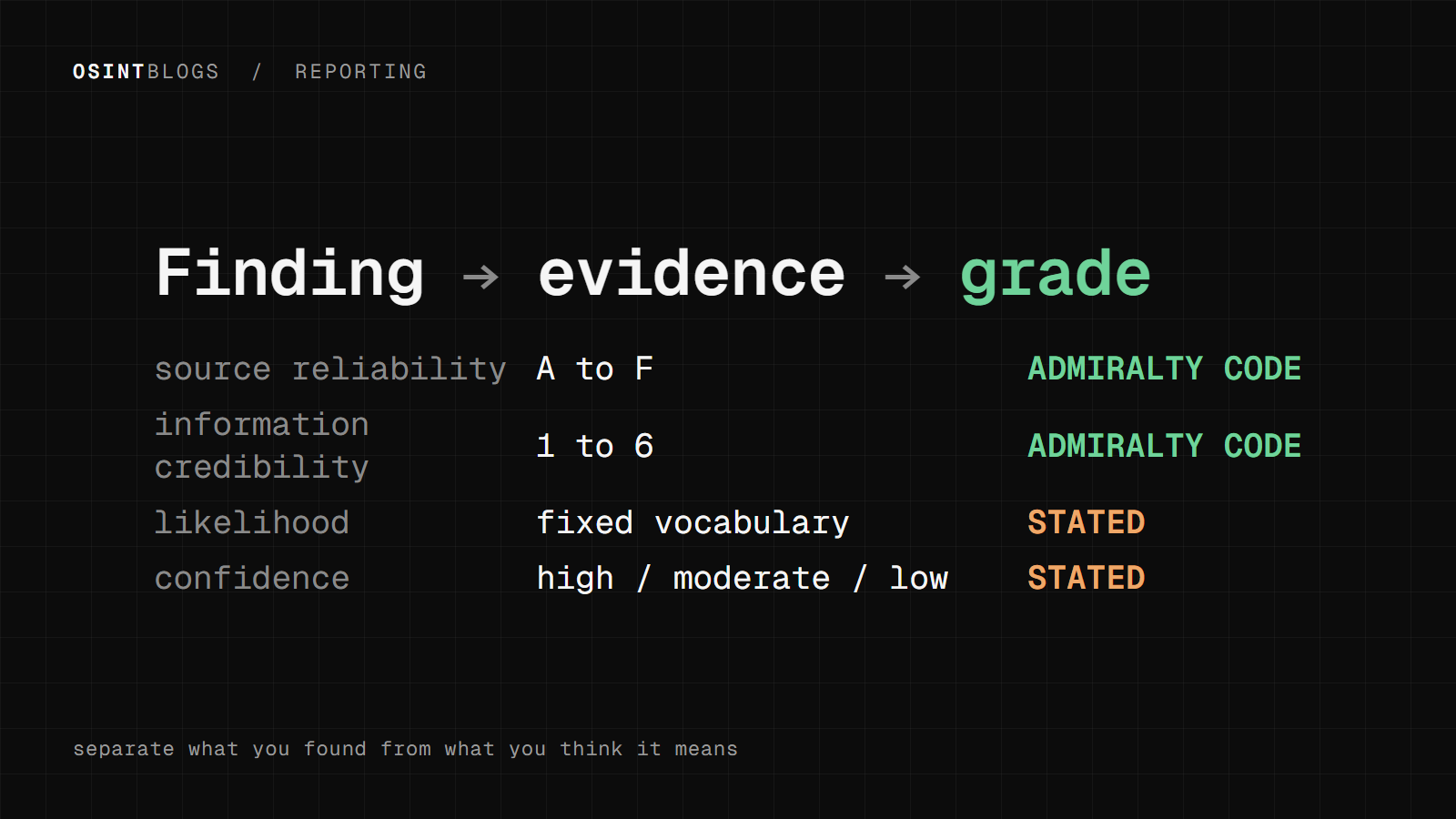
Grading sources and wording confidence. See our OSINT report template.
Evidence handling. See preserving web evidence.
Writing. Short, plain, answer first. This is the skill employers complain most about not finding.
Practice: write up every exercise as if for a manager who has two minutes. What was the question, what is the answer, how sure are you, what did you not check?
Specialisms
Once the core is in place, most people go deeper in one or two areas:
Area | Typical work | Guides on this site |
|---|---|---|
Visual investigations | Verifying footage, conflict monitoring | Geolocation, chronolocation, satellite imagery |
Cyber threat intelligence | Tracking malicious infrastructure and actors | Domains, Shodan, dark web, breach data |
Financial crime and due diligence | Screening, ownership, fraud | Due diligence, company checks, crypto tracing |
Transport and trade | Sanctions evasion, logistics | Ship tracking, flight tracking |
Social media and disinformation | Networks, coordinated behaviour | Platform guides |
Build a portfolio
A certificate says you sat a course. A write-up shows how you think. For hiring managers in this field, the second counts for more.
Publish worked examples. A geolocation solved step by step, an analysis of a scam website's infrastructure, a method note on a tool. Explain dead ends as well as the answer.
Show your reasoning and your limits. State confidence, alternatives considered and what you could not establish.
Keep it ethical. No private individuals, no personal data that does not need to be there, nothing that helps someone cause harm.
Contribute. Fix an entry in an open tool list, report a broken username check, answer questions in community forums.
Be consistent. Six solid write-ups over six months beat one viral post.
OSINTblogs is open to contributors, and a reviewed write-up here is a reasonable first portfolio piece.
Jobs that use OSINT
Few job adverts say "OSINT analyst". Search for the work instead.
Threat intelligence analyst in security teams and vendors.
Fraud, financial crime or KYC analyst in banks, fintechs and marketplaces.
Due diligence or corporate investigations analyst in consultancies and law firms.
Trust and safety analyst on online platforms.
Intelligence analyst in police forces, government agencies and the military.
Researcher or visual investigations reporter in newsrooms and non-governmental organisations.
Brand protection and anti-counterfeiting analyst.
Security researcher, including the reconnaissance side of penetration testing.
Hiring managers consistently look for: clear writing, sound judgement about sources, evidence of curiosity, discretion, and usually a language or a domain specialism. Tool lists on a CV impress nobody.
Courses and certificates, honestly
You can learn the fundamentals free. Guides from investigative journalism organisations, verification handbooks, recorded conference talks and community challenges cover more than a beginner can absorb.
Paid courses buy structure and feedback. The well-regarded ones are expensive and are usually paid for by employers. They are worth it when someone else pays, or when you need the structure.
Certificates open some doors. Government and large corporate roles sometimes filter on them. Most employers in this field weigh demonstrated work more heavily.
Be wary of anything promising a job in weeks, or teaching "how to find anyone".
Adjacent qualifications help. A background in a language, law, accounting, journalism, data analysis or security is often what makes an OSINT candidate stand out.
Habits that last
Method over tools. Any tool you learn today may be gone in two years. Ask what a tool is doing, so you can do it another way.
Write everything down.
Disprove yourself. Look for the evidence that would show you are wrong.
Stay within the law and your remit.
Look after yourself. Some of this work involves disturbing material. Limit exposure, take breaks and talk to colleagues.
Keep reading. Platforms change monthly. Follow a few practitioners and one or two newsletters, and ignore the rest.
A first month, day by day
Week | Focus | Output |
|---|---|---|
1 | Search operators and public records | One-page profile of a local business from public records |
2 | Reverse image search and geolocation | Five solved geolocation challenges, written up |
3 | Researching yourself from one email address | A list of what is exposed, and what you changed |
4 | Domains and archives | A short report on who is behind a website of your choice, with sources |
By the end you will have four small pieces of work, a note-taking habit and a clear idea of which direction you enjoy.
Frequently asked questions
How long does it take to learn OSINT?
The basics take a few months of steady practice. Becoming reliably good at verification and analysis takes a year or two of real work, and nobody finishes learning, because the sources keep changing.
Do I need to know how to code?
No, to start. Basic command-line use and a little Python become very useful later, especially for technical specialisms and for handling larger amounts of data.
Can I learn OSINT for free?
Yes. Free guides, handbooks, challenges and community events cover the core skills. Paid training adds structure and feedback.
Is OSINT a good career?
Demand is steady across security, financial crime, journalism and government. Roles are rarely titled OSINT, so look for analyst and investigator positions that use these skills.
What is the best OSINT certification?
There is no single standard. A few vendor courses are well regarded and expensive. For most employers a portfolio of careful, ethical write-ups is more persuasive.