OSINT report template: structure, source grading and confidence
A copy-and-use OSINT report template with the reasoning behind each section. How to separate facts from assessments, grade sources with the Admiralty Code, use confidence and probability language consistently, keep a source log and state limitations.

· 6 min read
An investigation is only as useful as its report. The reader was not there while you searched. They cannot see which findings you checked three ways and which rest on one anonymous forum post, unless the report tells them.
A good OSINT report lets a reader do three things: get the answer in the first half page, see how strongly each point is supported, and retrace your steps. This guide gives a template that does that, and explains the parts people most often get wrong.
The principles behind the template
Answer first. Decision makers read the top and stop. Put conclusions there, not at the end of a narrative.
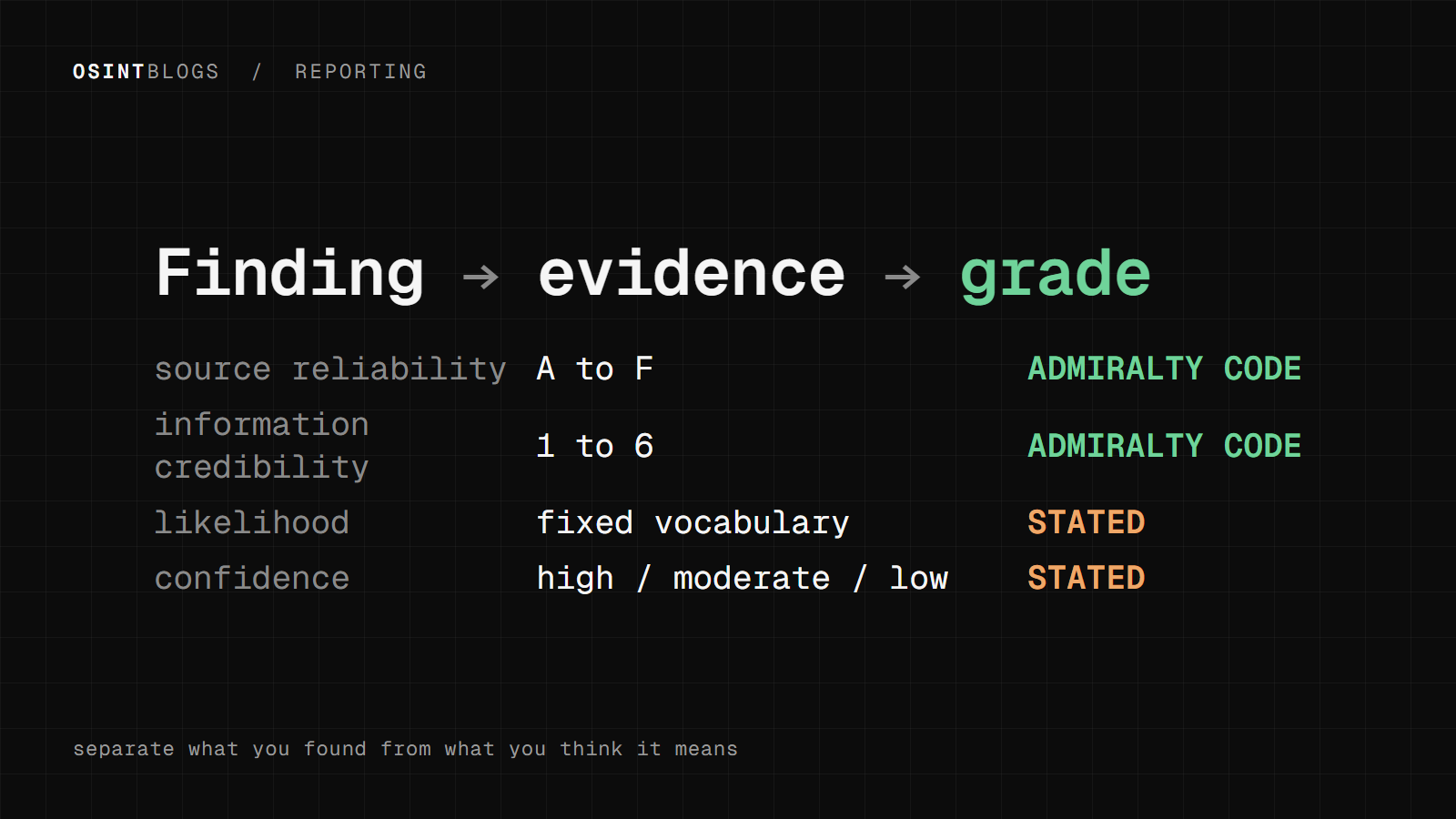
Separate what you found from what you think. "The domain was registered on 3 March" is a finding. "The same person probably runs both sites" is an assessment. Keep them visibly apart.
Grade your sources. Not all evidence is equal, and the reader should not have to guess.
Use words for likelihood consistently. "Likely" should mean the same thing on page two as on page nine.
Make it checkable. Every finding points to a logged source that someone else could open.
State what you did not do. Limits are part of the result.
The template
Copy this and adapt the headings to your organisation.
# [Subject] - open-source research report

Reference:        [case or request number]
Prepared by:      [name, role]
Prepared for:     [requester]
Date of report:   [date]
Research period:  [first and last date of collection]
Handling:         [who may see this, how it must be stored]

## 1. Question and scope
- The question asked: [one or two sentences, in the requester's terms]
- In scope: [subjects, identifiers, time period, source types]
- Out of scope: [what was excluded, and why]
- Authority and lawful basis: [who approved, legal basis for processing]

## 2. Key findings
1. [Finding or assessment, with confidence level. Evidence refs: E-001, E-004]
2. [...]
3. [...]

## 3. Background
[Only what the reader needs to understand the findings.]

## 4. Findings in detail
### 4.1 [Topic]
Established: [facts, each with evidence reference and source grade]
Assessment: [what these facts indicate, with likelihood wording]
Alternative explanations considered: [and why they were kept or set aside]

### 4.2 [Topic]
[...]

## 5. Gaps and limitations
- [Sources that could not be accessed]
- [Questions that remain open]
- [Known weaknesses in the evidence]

## 6. Method
[Identifiers started from, tools and sources used, dates, accounts used,
anything a second analyst needs to repeat the work.]

## 7. Suggested next steps
[Optional. Only if asked for.]

Annex A: source log
Annex B: captures and hashes
Annex C: glossary
Writing the key findings
This section carries the report. Keep it to between three and seven numbered points, each able to stand alone if quoted without the rest.
A weak finding:
The subject appears to have links to several companies and some concerning online activity.A stronger version of the same thing:
The subject is listed as a director of three UK companies, two of them dissolved (E-003 to E-005, graded A1). It is likely that the subject also controls the trading name "Northgate Supplies": the business's website was registered using the subject's company email address (E-009, B2), and no other person is named on it.The second says what was found, where, how reliable the source is, what is inferred and on what basis.
Grading sources with the Admiralty Code
The Admiralty Code, also called the NATO system, gives each item two separate grades: one for the source and one for the information.
Grade | Source reliability |
|---|---|
A | Completely reliable. A history of full reliability |
B | Usually reliable. Minor doubt |
C | Fairly reliable. Some doubt, has been right before |
D | Not usually reliable. Significant doubt |
E | Unreliable. A history of invalid information |
F | Reliability cannot be judged |
Grade | Information credibility |
|---|---|
1 | Confirmed by other independent sources |
2 | Probably true. Logical and consistent, not confirmed |
3 | Possibly true. Reasonably logical, agrees with some other information |
4 | Doubtful. Possible but not logical, no other support |
5 | Improbable. Contradicted by other information |
6 | Truth cannot be judged |
The two grades are independent, and this is why the system works. A reliable source can pass on something wrong, and an anonymous account can post something true.
How it applies to open sources:
An official register, such as a company registry, is normally A or B as a source. Its content is 1 or 2, bearing in mind that registries record what was filed, and filings can be false.
An anonymous social media account you have never seen before is F as a source. A single uncorroborated claim from it is F6. Most raw open-source material starts here.
Corroboration raises the second grade. If two sources that do not depend on each other say the same thing, the information moves towards 1. Two accounts reposting the same original are one source, not two.
Track record raises the first grade. A channel you have checked against known events for a year, and found accurate, can move from F to C or B.
Tool output is not a source. A lookup tool reports data from somewhere. Grade the underlying data, and record the tool as the method.
Put the grade beside each evidence reference, as in "E-009, B2". Readers pick the system up within a page.
Words for likelihood and confidence
Likelihood is how probable you think something is. Confidence is how good the evidence behind that judgement is. They are different, and a report can need both: "It is likely, with low confidence, that the two accounts are run by the same person."
Analysts and readers interpret words like "possibly" very differently unless they are pinned down. The UK intelligence community's probability yardstick is a widely used scale:
Term | Approximate probability |
|---|---|
Remote chance | 5% or less |
Highly unlikely | 10% to 20% |
Unlikely | 25% to 35% |
Realistic possibility | 40% to 50% |
Likely or probable | 55% to 75% |
Highly likely | 80% to 90% |
Almost certain | 95% or more |
Whichever scale you adopt, print it in the glossary and use only its terms for assessments. Do not write "may", "could" or "might well" for a judgement, because nobody can tell where they sit.
For confidence, three levels are enough:
High. Several independent, well-graded sources agree, with little conflicting information.
Moderate. Credible sources, but few of them, or with gaps that other explanations could fill.
Low. Thin, uncorroborated or partly contradictory evidence.
Use plain statements for facts. "The domain was registered on 3 March 2026" needs no likelihood word. Hedging a fact makes it sound like a guess.
The source log
The log is what makes the report checkable. One row per item:
Field | Purpose |
|---|---|
Reference | E-001, E-002 and so on, cited in the text |
Description | What the item is, in a line |
Address | The full link |
Date and time accessed (UTC) | When you saw it |
Date of the content | When it was published or recorded |
Capture file and hash | Where your copy is, and its SHA-256 |
Archive link | An independent copy, if one exists |
Grade | Admiralty source and information grades |
Notes | Context, caveats, how it was found |
Fill it in as you work. Reconstructing a log at the end always loses things. Our guide to preserving web evidence covers captures, hashes and timestamps.
Limitations, written honestly
A limitations section protects the reader from over-reading the report, and protects you when new facts emerge. State:
what you could not access, such as private accounts, paid databases and sources in languages you do not read
the period covered, since open sources change daily
identifiers you could not confirm belong to the subject
names that are common, and how you told people apart
that absence of findings is not evidence of absence
A negative result deserves the same care as a positive one. "No adverse media was found in English-language sources searched on the dates given" is a finding. "The subject is clean" is not something open sources can establish.
Handling personal data in reports
Reports about people are personal data. Include what answers the question and leave out what does not, however interesting. Omit third parties, such as family members, unless they are part of the finding. Mark the report with who may read it and when it should be reviewed or deleted. Our overview of whether OSINT is legal explains the reasoning.
Before you send it
Does the first half page answer the question that was asked?
Is every finding tied to an evidence reference?
Is every assessment worded with a term from your scale?
Are facts and assessments kept apart?
Have you considered and recorded another explanation for each key assessment?
Could a colleague repeat the work from the method section?
Have you removed personal data the reader does not need?
Has someone else read it?
If you are new to the field, our guide to what OSINT is sets out the wider process that the report sits at the end of.
Frequently asked questions
How long should an OSINT report be?
As short as the question allows. Most readers need one to three pages plus annexes. Put the detail in the annexes and keep the body for findings.
What is the Admiralty Code in OSINT?
A two-part grading system. A letter from A to F rates the reliability of the source, and a number from 1 to 6 rates the credibility of the information. An unknown source making an unverified claim is F6.
What is the difference between confidence and probability?
Probability is how likely you judge something to be. Confidence is how strong the evidence for that judgement is. You can judge something likely while having low confidence, if the evidence is thin.
Should I include screenshots in the report?
Yes, where they help the reader, with the evidence reference beneath each. Keep the full captures and hashes in an annex or evidence folder, since a screenshot in a document is an illustration, not the evidence itself.
Should an OSINT report make recommendations?
Only if you were asked for them. The analyst's job is to say what is known and how well. What to do about it usually belongs to the reader.