Is OSINT legal? What the law allows in the US, UK and EU
Collecting public information is generally lawful, but public does not mean unregulated. Where the legal lines sit for OSINT in the US, UK and EU: unauthorised access, data protection, scraping and terms of service, pretexting, harassment and regulated uses.

· 9 min read
The short answer is yes: reading and analysing publicly available information is lawful in the United States, the United Kingdom and the European Union. Journalists, compliance teams, security researchers and police forces do it every day.
The longer answer is that "it was public" settles less than people expect. How you obtained the information, what you do with it, and whose information it is can each turn lawful research into something else. This guide maps the main lines. It is general information, not legal advice, and the details in any real case depend on your country, your role and the facts.
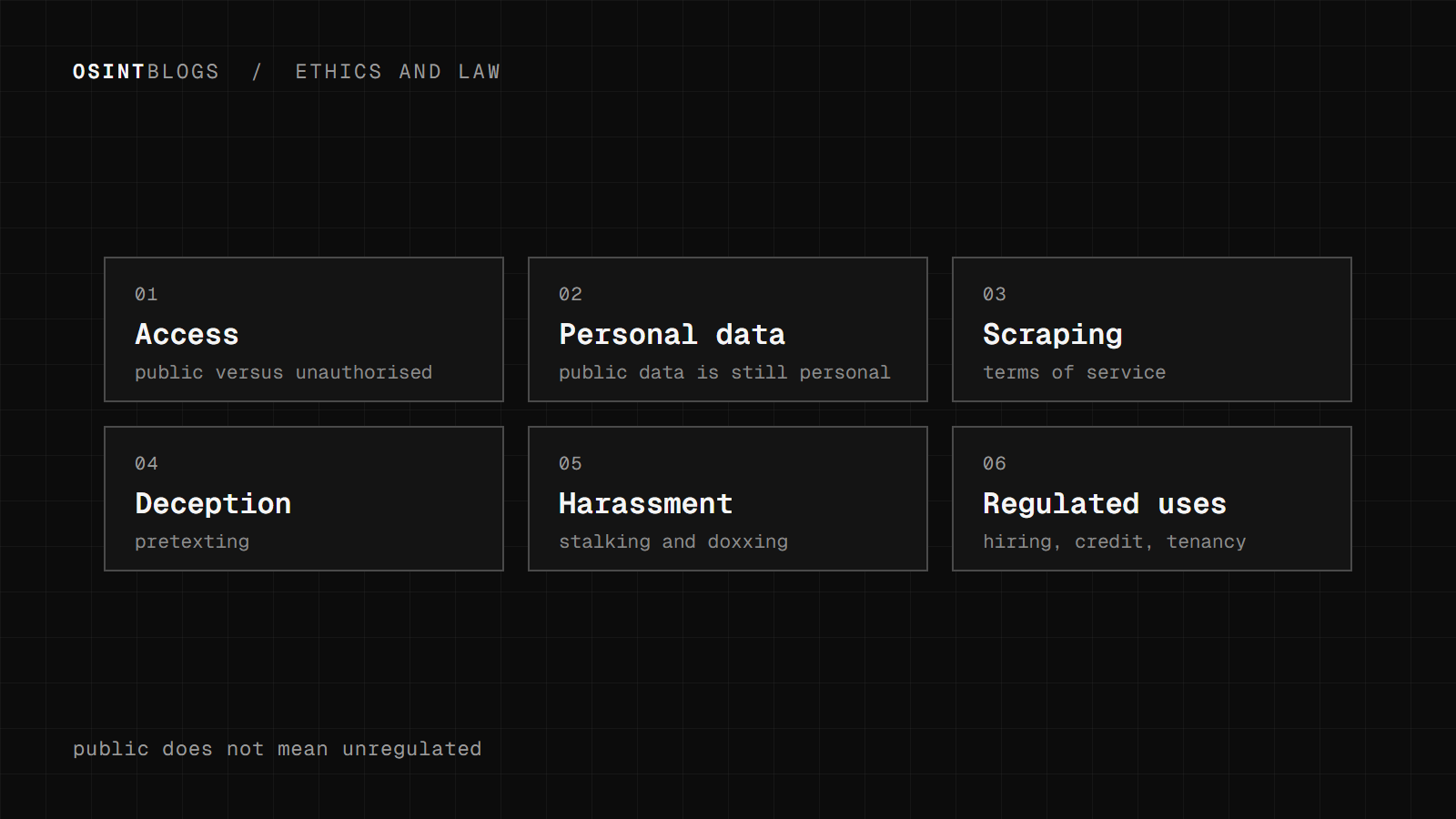
The six lines that matter
Line | The question | Where it bites |
|---|---|---|
Access | Did you get past a barrier you had no permission to pass? | Everywhere |
Personal data | Do you have a lawful reason to collect and keep data about a person? | EU and UK strongly, a growing number of US states |
Terms and scraping | Did you breach a contract with the platform? | Everywhere, mostly as a civil matter |
Deception | Did you pretend to be someone to obtain information? | Everywhere, with specific US offences |
Conduct towards the subject | Does the activity amount to harassment or stalking? | Everywhere |
Regulated use | Is the result used for a decision the law controls? | US background checks, EU and UK screening |
Line 1: public access versus unauthorised access
Every jurisdiction covered here makes it a crime to access a computer system without authorisation: the Computer Fraud and Abuse Act in the US, the Computer Misuse Act 1990 in the UK, and national laws implementing the EU directive on attacks against information systems.
For OSINT, this means in practice:
Lawful: reading pages that any visitor can load, querying public registries, using search engines, reading data that scanning services have already collected.
Unlawful: guessing or reusing passwords, logging in with credentials found in a leak, exploiting a flaw to see more than the site intended, and getting round an access control such as a login wall.
Depends on the country: actively scanning systems you do not own. Port scanning is tolerated in some places and prosecuted in others. Reading the results of someone else's scan is a different act from scanning.
Finding a password in a public data leak is not the offence. Typing it into the login page is. Good intentions are not a defence in most of these laws, and the UK statute has no general exception for security research.
In the US, the Supreme Court's 2021 decision in Van Buren narrowed the federal law to cases of entering parts of a system that are off limits to you, and away from misuse of access you do have. That helped researchers, but it did not license bypassing barriers.
Line 2: public data is still personal data
This is the point most often misunderstood, particularly by people trained in the US and working on European subjects.
Under the GDPR and the UK GDPR, information about an identifiable living person is personal data whether or not it is public. Collecting someone's public posts into a file is "processing", and the law applies in full. It applies to organisations anywhere in the world when they monitor the behaviour of people in the EU or UK.
What that requires of an organisation doing OSINT:
A lawful basis. Usually legitimate interests, which means a three-part test: a real purpose, processing that is necessary for it, and a balance against the person's rights and reasonable expectations. Write the test down.
Data minimisation. Collect what the purpose needs. A fraud check does not need the subject's holiday photos.
Extra care with special categories. Health, religion, political opinions, sexual orientation, ethnicity and biometric data need a further legal condition. So does data about criminal convictions.
Transparency. People are normally entitled to be told when their data is collected from elsewhere. There are exceptions, for example where telling them would defeat a fraud investigation, but they have to be justified.
Security and retention. Protect what you hold and delete it when the purpose ends.
Journalism, academic research and law enforcement have their own exemptions and rules. Purely personal activity by an individual falls outside the GDPR, though publishing what you find to the world generally does not.
Regulators have enforced this against firms whose whole model was collecting public data. Clearview AI, which built a face search engine from scraped public photos, has been fined tens of millions of euros by data protection authorities in France, Italy, Greece and the Netherlands.
The US has no federal equivalent. A growing number of states, led by California, have privacy laws, though most exempt publicly available information to some degree. Illinois regulates biometric data strictly, including face recognition.
Line 3: terms of service and scraping
Nearly every platform's terms prohibit automated collection, and most prohibit fake accounts. Breaching terms is a breach of contract. It is rarely a crime in itself.
The US cases give the general shape:
In hiQ v. LinkedIn, the appeals court held in 2022 that scraping pages open to the public probably does not violate the federal computer crime law. The same litigation later found that hiQ had breached LinkedIn's user agreement, and it ended in a settlement against hiQ.
In Meta v. Bright Data, a federal court ruled in 2024 that Meta's terms did not bar scraping of public pages by someone who was logged out, because the terms bind users of an account.
The practical pattern: collecting public pages while logged out carries the least risk, collecting while logged in means you agreed to the terms and can be held to them, and anything behind a login is treated more seriously. In Europe, add data protection law to the same analysis, and database rights where a substantial part of a database is extracted.
The realistic consequences of breaching terms are account bans, blocked addresses and, for organisations collecting at scale, lawsuits. For an organisation, "a criminal prosecution is unlikely" is not the same as "this is fine". Decide on scraping as a policy matter, with legal input.
Line 4: deception and pretexting
Open-source research is passive: you observe what is published. Contacting a subject or a company while pretending to be someone else is not open-source research, and laws target it directly.
In the US, obtaining someone's financial records by false pretences is an offence under the Gramm-Leach-Bliley Act, and obtaining phone records by pretexting is a federal crime under a 2006 law.
Impersonating a real person, a police officer or an official is an offence almost everywhere.
In the UK, deceiving someone into handing over personal data can be an offence under the Data Protection Act 2018, and public bodies need authorisation under surveillance law before running covert online personas.
Research accounts sit in a grey zone. A blank account used only to view public content breaches most platforms' terms but deceives nobody. A persona with an invented history, used to befriend a subject or get into a closed group, is covert human contact. Law enforcement needs authorisation for it, and private investigators and journalists need a clear ethical and legal justification.
Line 5: harassment, stalking and doxxing
The same collection can be lawful for one purpose and criminal for another. Compiling a person's address, workplace, routine and family for a due diligence report is research. Compiling them to intimidate, follow or expose that person is harassment or stalking, and many jurisdictions now have specific offences for publishing personal details to cause harm.
Repeated monitoring of one individual can itself amount to harassment in UK law if it causes alarm or distress, even where each piece of information was public.
Purpose is the test. If you cannot state a legitimate reason for wanting the information, do not collect it. See our guide to what OSINT is for how purpose shapes the whole process.
Line 6: regulated uses
Some decisions are regulated regardless of where the information came from.
US background checks. Under the Fair Credit Reporting Act, information used to decide on employment, tenancy, credit or insurance must come through a process with consent, accuracy duties and a right to dispute. Looking up a job candidate on a people-search site that says it is not a consumer reporting agency, and rejecting them on the result, is the classic violation.
Employment screening in the EU and UK. Checking candidates' social media needs a lawful basis, relevance to the role and notice to the candidate. Decisions based on protected characteristics seen online are discrimination.
Private investigator licensing. Most US states and several European countries require a licence to investigate for hire. The UK does not currently license investigators.
Breach data
Leaked and stolen data sets are widely used in security research and are legally the least settled area. Points most lawyers agree on:
Checking whether an address appears in a breach, through a service that does not reveal the data, is low risk.
Downloading, holding and searching full breach files containing passwords and personal data is high risk under data protection law in Europe, and may involve handling stolen data.
Paying criminals for data funds the crime.
Using leaked credentials is unauthorised access, without exception.
Organisations that use breach data should have a written policy, a named purpose such as protecting their own staff and customers, and legal sign-off.
A pre-flight check
Before starting, be able to answer:
Purpose. What is the question, and who needs the answer?
Authority. Who approved this, and under what policy?
Lawful basis. If the subject is a person in the EU or UK, what is the basis, and where is it recorded?
Access. Will everything be collected from places open to any visitor? If not, stop and get advice.
Interaction. Will you contact or deceive anyone? If so, this is no longer only OSINT.
Minimum. What is the least data that answers the question?
Use. Will the result feed a regulated decision?
Retention. Where will it be stored, who can see it, and when is it deleted?
Write the answers down. A short record made before the work begins is the most persuasive evidence of good faith, and it belongs in the report. Our OSINT report template has a place for it.
Frequently asked questions
Is OSINT legal?
Yes. Collecting and analysing publicly available information is lawful. It becomes unlawful through how it is done, such as bypassing access controls or deceiving people, or why, such as harassment, or through mishandling personal data.
Is web scraping legal?
Scraping public pages is not generally a crime in the US, UK or EU, but it usually breaches the site's terms, and in Europe scraping personal data needs a lawful basis under the GDPR. The risk is mainly civil and regulatory, and rises sharply for logged-in or large-scale collection.
Does GDPR apply to publicly available information?
Yes. Information about an identifiable person is personal data even when the person published it. You need a lawful basis to collect and use it.
Is it legal to use a fake account for OSINT?
It breaches almost every platform's terms. Whether it breaks the law depends on what you do with it. Passive viewing is rarely unlawful in itself. Using a false identity to interact with or deceive people can be, and regulated professions have their own rules.
Is doxxing illegal?
In many places, yes, either under a specific offence or under harassment, stalking and data protection laws. Publishing someone's personal details to expose them to harm is not research.
Can I use leaked data in an investigation?
With great caution. Confirming that an identifier appears in a breach is generally defensible. Holding and exploiting full breach files, or using leaked passwords, exposes you to data protection and computer misuse liability.