What is OSINT? A practical guide to open-source intelligence
OSINT is intelligence produced from information anyone can lawfully get. What counts as open, how an investigation actually runs, a worked example you can repeat, and the legal and ethical limits.

· 8 min read
OSINT, short for open-source intelligence, is intelligence produced from information that anyone can lawfully obtain: websites, public records, social media, satellite imagery, company filings, leaked-but-published documents, radio signals from ships and aircraft. The "open" refers to the sources, not to software licences. No passwords are guessed and no systems are broken into.
The second word matters as much as the first. A pile of search results is information. It becomes intelligence when it has been collected against a specific question, checked, and written up so that someone can act on it. Most beginner frustration with OSINT comes from skipping that step: running tools without a question, and ending up with data nobody can use.
A working definition
The definition used in United States law is a good one to memorise. The National Defense Authorization Act for 2006 describes open-source intelligence as intelligence that is "produced from publicly available information and is collected, exploited, and disseminated in a timely manner to an appropriate audience for the purpose of addressing a specific intelligence requirement".
Three things in that sentence are worth noticing:
Publicly available. The source is open to the public by purchase, request, observation or simply by looking. A court filing behind a small fee is open. A private group chat you joined under a false name is, at best, contested.
A specific requirement. There is a question. "Find everything about this company" is not a requirement. "Who controls this company, and is it connected to the sanctioned firm at the same address?" is.
An audience. The result is delivered to someone: an editor, a client, a security team, a court.
Who uses OSINT
OSINT started as a discipline inside state intelligence services, which have monitored foreign newspapers and radio for most of a century. Today most of the people doing it work elsewhere:
Journalists and researchers verify footage, locate where and when events happened, and trace money and ownership.
Security teams map what their own organisation exposes to the internet and track the infrastructure of the groups attacking them.
Fraud and compliance teams check that customers, suppliers and counterparties are who they claim to be.
Human rights investigators document incidents to a standard that can be used in legal proceedings.
Law enforcement uses open sources for leads, missing-person cases and threat assessment.
The techniques overlap heavily. The standards of proof, and the rules about what you may do with the results, differ a great deal.
What counts as an open source
Source type | Examples | Typical questions it answers |
|---|---|---|
The indexed web | News, blogs, forums, documents found with search operators | What has been published about this? |
Social media | Public posts, profiles, follower relationships, comments | Who said what, when, and who are they connected to? |
Public records | Company registries, court records, land records, procurement data | Who owns, controls or was paid by whom? |
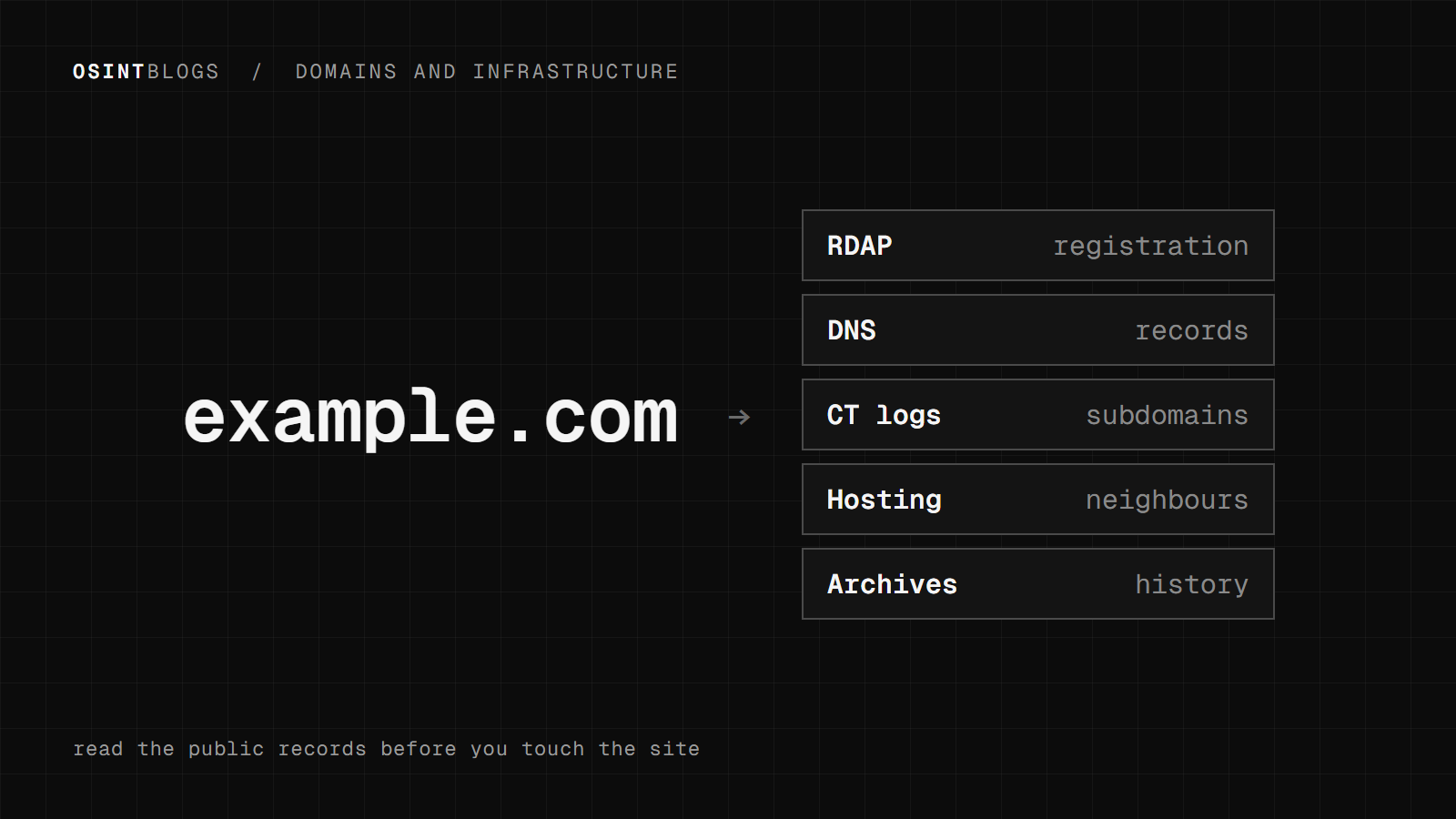
Technical records | DNS, RDAP registration data, certificate logs, IP allocations | What infrastructure exists and how is it linked? |
Imagery and maps | Satellite imagery, street-level photos, terrain data | Where and when was this photo or video taken? |
Tracking data | Aircraft transponders (ADS-B), ship transponders (AIS) | Where was this vessel or aircraft? |
Archives | The Wayback Machine, archive.today, library collections | What did this page say before it changed? |
Grey literature | Academic papers, patents, conference slides, job adverts | What is an organisation building or buying? |
Breach data sits at the edge. A notification service such as Have I Been Pwned, which tells you that an address appeared in a breach without showing the stolen data, is widely accepted. Downloading and searching raw credential dumps is a different thing: the data was stolen, it contains other people's passwords, and possessing it is unlawful in some places. Decide where your line is before you need to.
Passive and active collection
A distinction that matters in practice is whether the subject can see you looking.
Passive collection touches only third parties. Reading certificate logs, querying a registry, or viewing an archived copy of a page leaves no trace on the subject's own systems.
Active collection contacts the subject directly. Visiting their website from your own connection, viewing a LinkedIn profile while logged in, sending a friend request, or scanning their servers all leave marks they can find. Some of it, such as port scanning without permission, can also be unlawful.
A simple test: if your activity would appear in the subject's logs or notifications, it is active. Start passive, and move to active collection only when you have a reason and, where needed, permission.
How an investigation runs: the intelligence cycle
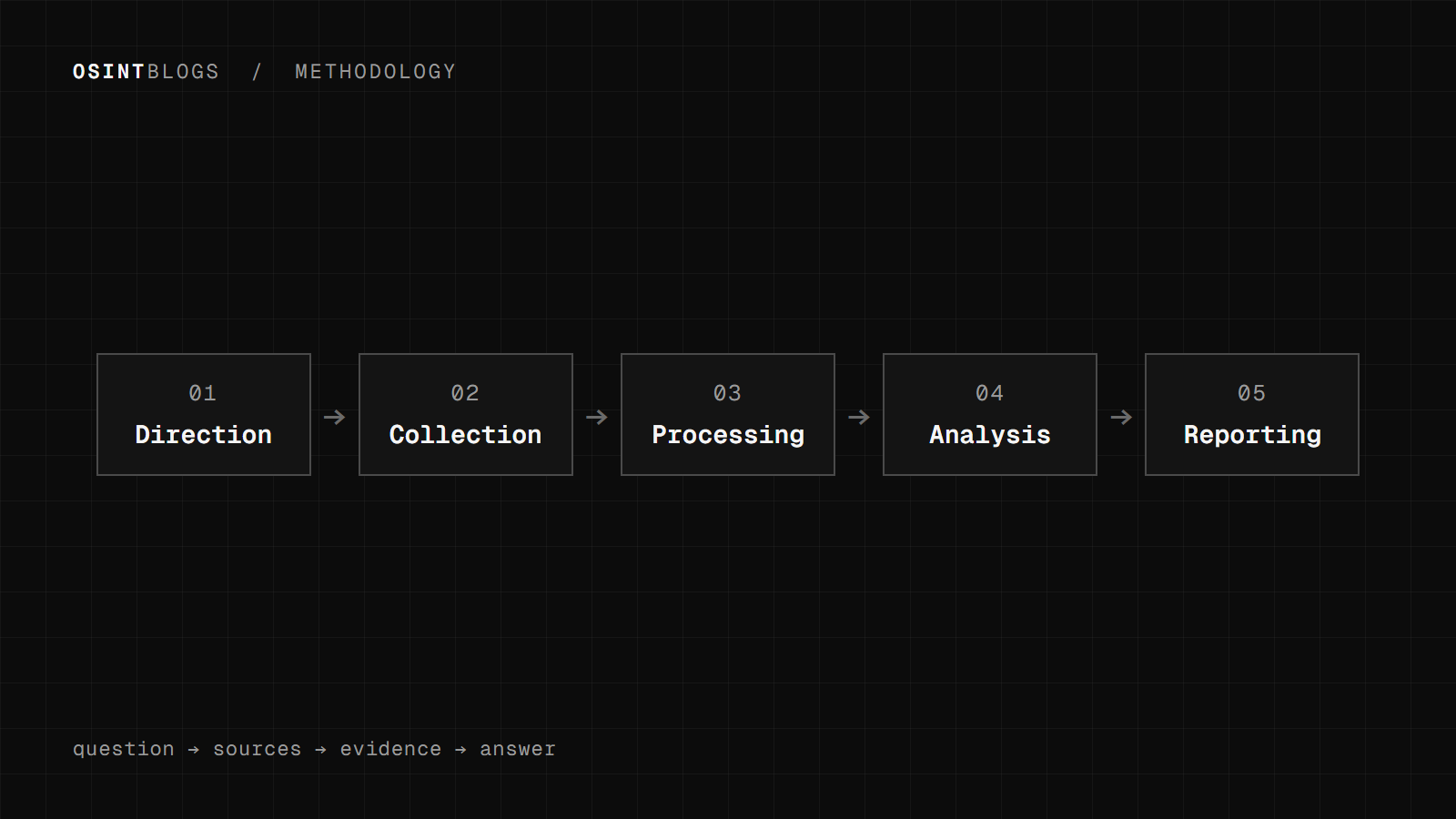
Almost every OSINT method is a variation on the same loop.
Direction. Write the question down in one or two sentences. Note what you already know and what would count as an answer.
Collection. Gather material from the sources most likely to answer the question. Save a copy of everything as you go, with the address and the time you saw it. Pages disappear.
Processing. Get the material into a usable form: translate it, extract dates and names, put events on a timeline.
Analysis. Test what you have. Does a second, independent source support it? What else would be true if your conclusion were right, and is it?
Dissemination. Write the answer for the person who asked, stating what you verified, what you infer, and how confident you are.
The loop repeats. Each answer usually produces a sharper question.
A worked example: is this online shop real?
Suppose a relative is about to buy an expensive camera from a shop they have never heard of. The question is narrow: is this a genuine business that is likely to deliver? Everything below can be done in half an hour with free sources, and none of it touches anything private.
Check the domain's age. Look up the registration record through RDAP. A shop claiming "20 years of experience" on a domain registered six weeks ago has some explaining to do. Our guide to investigating a domain covers the lookup.
Look for the legal entity. A genuine shop names a company and an address, usually in its terms or footer. Search the national company registry for that name. Does the company exist, is it active, and does the registered activity match selling cameras?
Check the address. Look at the address in street-level imagery. A warehouse or a shopfront is consistent. A residential flat or an empty field is not, on its own, proof of fraud, but it is a discrepancy.
Reverse-search the product photos and the "team" photos. Photos lifted from another retailer or from stock libraries are a common sign of a cloned shop.
Read the page history. An archived copy may show the same domain selling something unrelated a month ago. Read archived pages carefully, because a Wayback capture is not a screenshot.
Search for the shop's name with words such as "scam" or "not delivered". Weigh what you find: a few angry reviews are normal for any retailer, while no footprint at all for a supposedly long-established shop is odd.
No single check is decisive. A new domain plus stolen photos plus a company that does not exist is a clear answer. That is how most OSINT conclusions are reached: several weak, independent signals that point the same way.
The legal and ethical limits
"It was public" is where the legal analysis starts, not where it ends.
Data protection law still applies. In the EU and UK, the GDPR covers personal data even when it was published openly. Collecting, storing and sharing it needs a lawful basis.
Access matters. Getting past a login, a paywall or a technical barrier without permission can breach computer misuse laws such as the Computer Fraud and Abuse Act in the US or the Computer Misuse Act in the UK, even if the door was badly locked.
Terms of service are contracts. Scraping, or using fake accounts, breaks the terms of most platforms. That is usually a civil matter rather than a crime, but it can lose you the account and the evidence with it.
Harm is the real test. Publishing a private person's address or workplace can be lawful and still wrong. Ask who could be hurt if your findings were shared, and whether the purpose justifies it.
Mistakes beginners make
Collecting without a question. Tools produce output whether or not it is relevant.
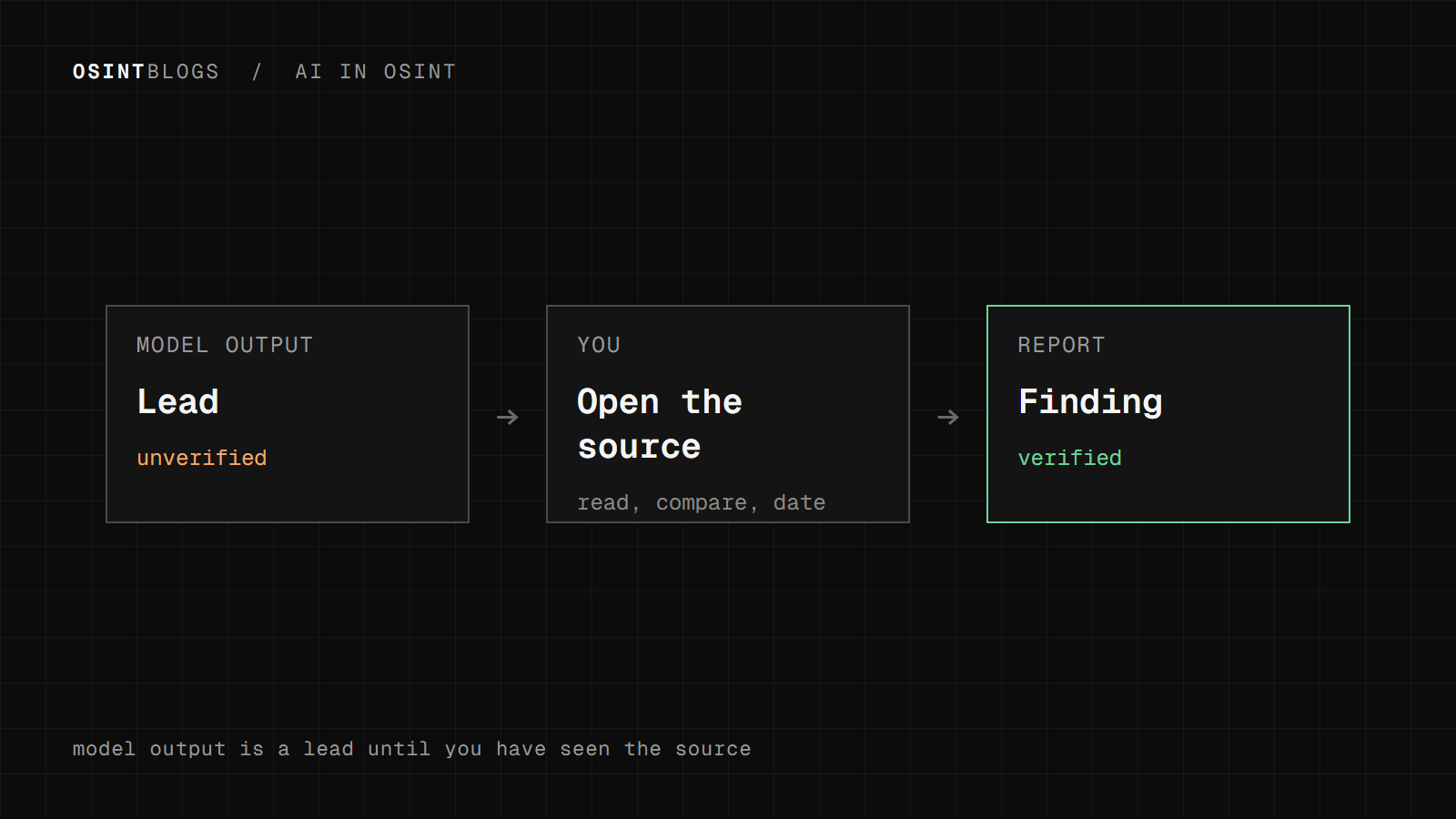
Trusting a single source. One profile with the right name is a lead, not an identification.
Not saving evidence. If you did not capture it, with its address and the time, you may not be able to show it later.
Confirmation bias. Once you have a theory, look for what would disprove it.
Forgetting your own exposure. Research from a separate browser profile, and think before you log in to anything with a personal account.
How to start practising
Pick skills rather than tools. Three exercises teach most of the fundamentals:
Geolocate a photo. Take a street photo with no caption and work out where it was taken from signs, architecture, road markings and terrain. Then work out when: our write-up on reading the time from a shadow shows one method.
Audit yourself. Search for your own name, email addresses and usernames as a stranger would. It is legal, it is safe, and it shows you what the techniques really return.
Trace a company. Pick a business you know and find its legal entity, directors and registered address from official registries.
When you want tools, our shortlist of free OSINT tools by task is a reasonable starting kit, and the Google dorks cheat sheet covers the search skills almost every investigation leans on.
Frequently asked questions
Is OSINT legal?
Collecting information from public sources is generally legal. What you do next can change that: getting around access controls, harassing someone, or mishandling personal data are not made lawful by the fact that the starting point was public. Laws differ between countries, so check the ones that apply to you and to the person or organisation you are researching.
Is OSINT the same as hacking?
No. OSINT uses information that is already accessible. Hacking, in the sense of gaining unauthorised access, is specifically what it excludes. Penetration testers use OSINT in the reconnaissance stage, which is where the confusion comes from.
Do I need to know how to code?
No. Most investigations are done with a browser, careful note-taking and patience. Scripting helps when you need to repeat a task hundreds of times or work with large datasets, and it is worth learning later.
What is the difference between OSINT, SOCMINT and GEOINT?
SOCMINT is intelligence from social media, and GEOINT is intelligence from imagery and geospatial data. When the material is publicly available, both are specialisms within OSINT.