IP address OSINT: what an IP reveals and where it misleads
What you can establish from an IP address using open sources: the network that owns it, the kind of connection, what runs there and its reputation. Why geolocation is weaker than it looks, and why an IP is not a person.

· 8 min read
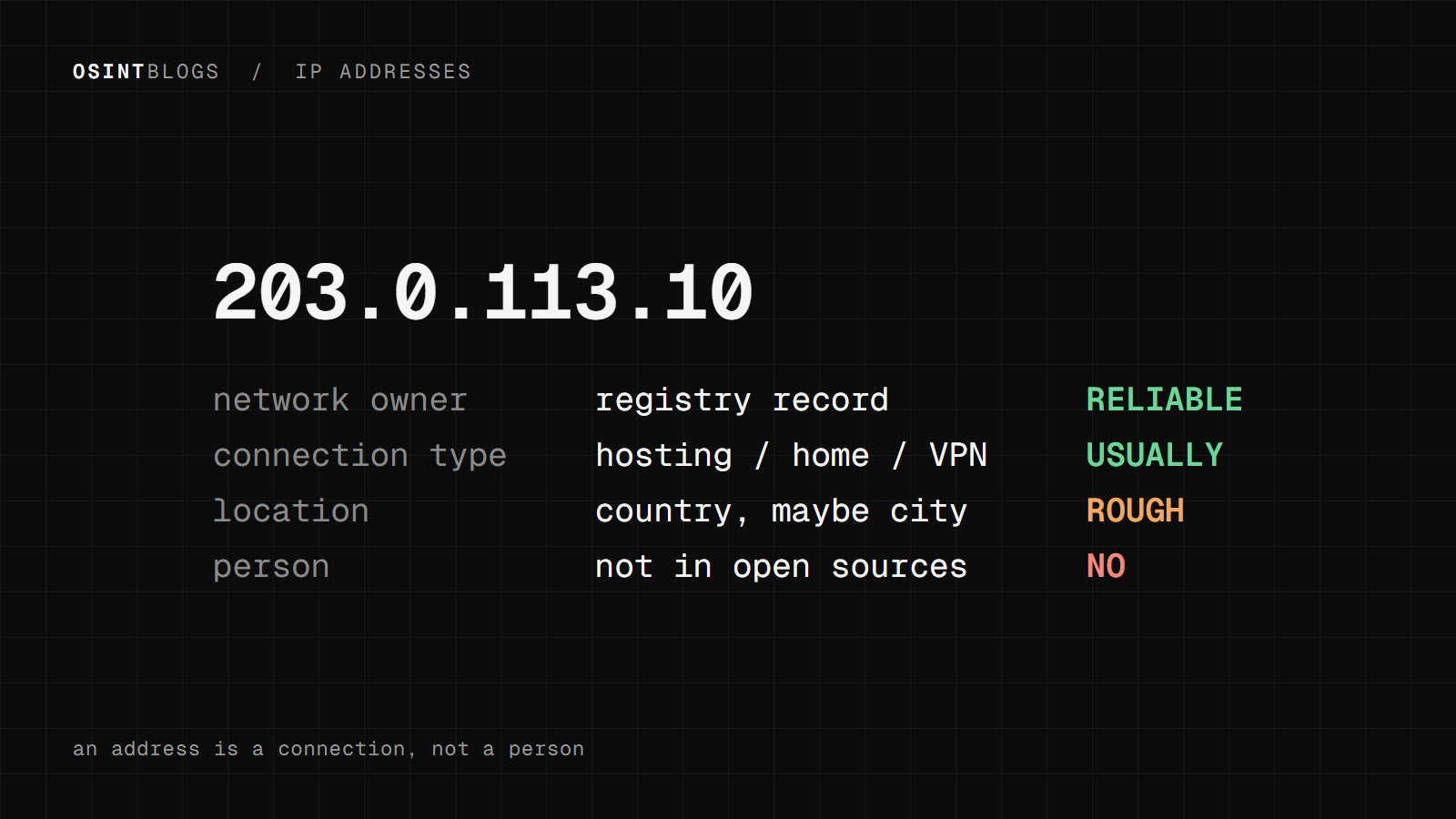
An IP address answers one question well and several questions badly. It tells you, reliably, which network an internet connection belongs to. It gives a rough and sometimes badly wrong idea of where that connection is. It does not tell you who was using it.
Most errors in IP research come from mixing those three up. This guide goes through what each open source can support, in order of reliability, and marks where the evidence runs out.
Five questions an IP address can answer
Question | Source | Reliability |
|---|---|---|
Who is responsible for this address? | Regional internet registry records, routing data | High |
What kind of connection is it? | Network type, reverse DNS, anonymiser lists | Medium to high |
What runs on it? | Internet scan data, passive DNS | Medium. It reflects a point in time |
Has it been reported for abuse? | Blocklists and reputation services | Medium. Needs dates and context |
Where is it? | Geolocation databases | Country: good. City: fair. Street: none |
Who is responsible for the address
IP addresses are handed out in blocks by five regional internet registries: ARIN for North America, RIPE NCC for Europe and the Middle East, APNIC for Asia-Pacific, LACNIC for Latin America and AFRINIC for Africa. Each publishes who holds every block. This is the firmest fact available about an address.
# Registry record through RDAP (redirects to the right registry)
curl -sL https://rdap.org/ip/203.0.113.10 | jq '{name, handle, country, startAddress, endAddress}'

# Network that announces the address, from Team Cymru
whois -h whois.cymru.com " -v 203.0.113.10"
203.0.113.10 is a placeholder from the range reserved for documentation. Substitute the address you are researching.
Two records matter, and they can differ:
The registry record names the organisation the block was allocated or assigned to. That may be an internet provider, a hosting company or a business with its own address space.
The autonomous system number (ASN) identifies the network that announces the address to the rest of the internet. Routing tools such as RIPEstat and bgp.he.net show the ASN, its other address ranges and the networks it connects to.
The registry record also carries an abuse contact. If the goal is to get malicious activity stopped, that is the address to write to.
A limit: the record names the network operator, not the customer. A block registered to a cloud provider tells you the server is rented from that provider and nothing about who rents it.
What kind of connection it is
The network type changes what every later finding means.
Residential or mobile. A household or handset. Usually dynamic: the provider reassigns addresses, so today's user may not be last month's.
Hosting or cloud. A server. Traffic from here is a program, a VPN or a proxy, rarely a person at a keyboard.
Business. An office network, where one address may stand in front of hundreds of staff.
Anonymiser. A commercial VPN, a Tor exit node, an open proxy or a privacy relay such as iCloud Private Relay.
Ways to tell them apart:
Reverse DNS.
dig -x 203.0.113.10 +shortreturns the host name the operator assigned. Names such aspool-,dyn-orcust-suggest residential lines, and many hosting companies include their own name. The operator can put anything there, so treat it as a hint.Tor exit lists. The Tor Project publishes the current list of exit nodes, and past lists are archived, so you can check whether an address was an exit on a given date.
Published ranges. Apple publishes the egress ranges for iCloud Private Relay, and major cloud providers publish theirs.
Classification services. IPinfo, IP2Location, Spur and others label addresses as hosting, VPN, proxy or residential. Their free tiers are enough for occasional checks. They disagree with each other at the edges, particularly for residential proxy networks, which route traffic through ordinary home connections.
What runs on the address
For servers, scan data shows what was listening.
Shodan and Censys continuously scan the internet and record open ports, software banners and TLS certificates. You are reading their records, not scanning anything yourself.
Shodan InternetDB is a free, keyless endpoint that returns open ports, host names and known vulnerabilities for an address:
curl https://internetdb.shodan.io/203.0.113.10.Certificates presented by the server list the domain names it serves, which is often the quickest way from an address to a website.
Passive DNS, from services such as VirusTotal and SecurityTrails, lists domains that have resolved to the address over time.
Bing's
ip:search operator lists indexed sites hosted on an address.
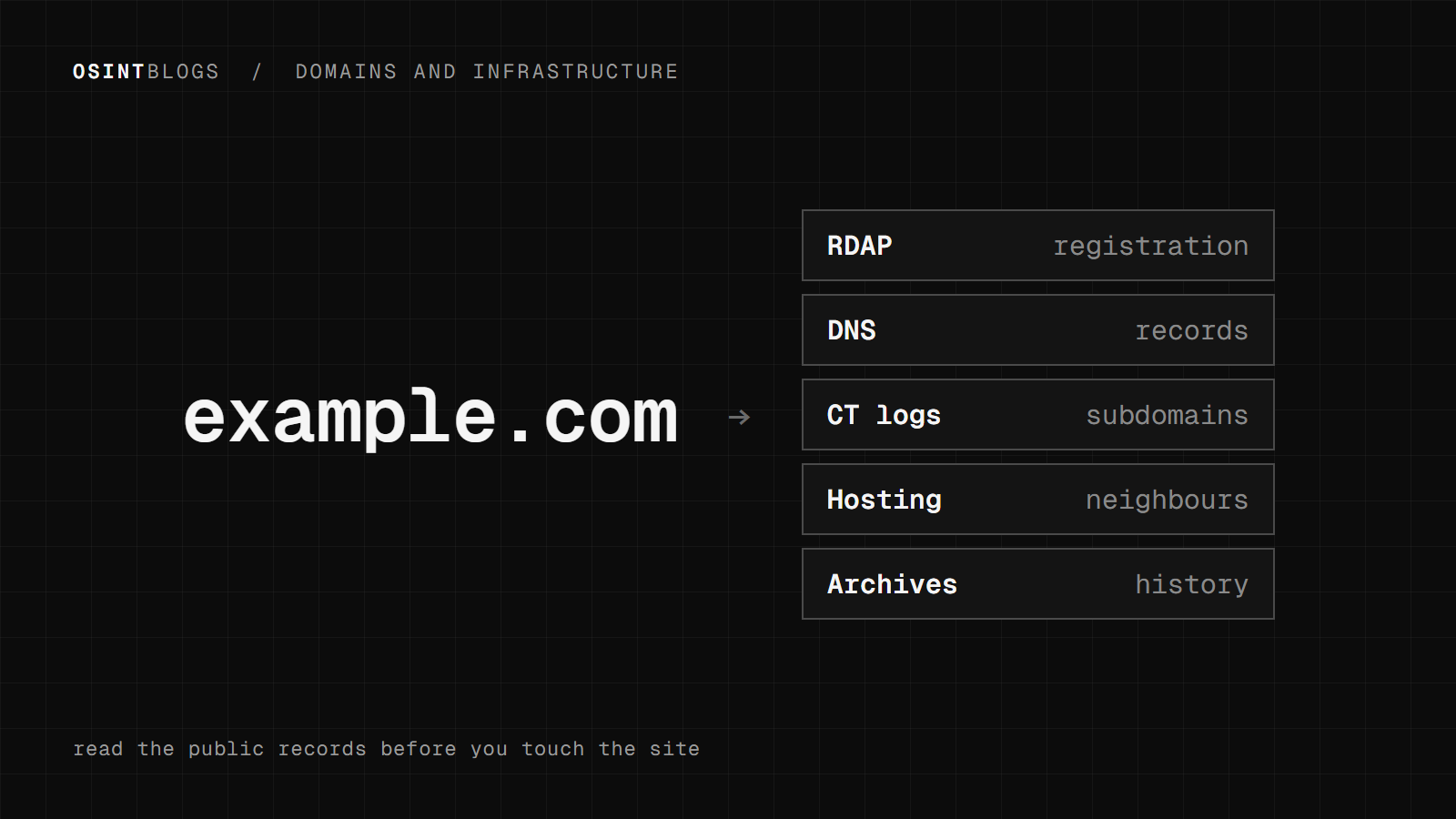
Check the date on everything. Cloud addresses are recycled quickly, and a scan from three months ago may describe a previous tenant. Shared hosting and content delivery networks put thousands of unrelated sites on one address, so a neighbour list from those proves no connection. Working from the domain side is covered in our guide to investigating a domain.
Reputation
Reputation services record what an address has been seen doing.
AbuseIPDB collects reports from server operators and gives a confidence score from 0 to 100, with the reports behind it.
GreyNoise runs sensors that listen for internet-wide scanning. It distinguishes addresses that scan everyone, which are background noise, from those that are not known scanners, which makes a hit on your own systems more interesting.
VirusTotal shows which security vendors flag the address, and files and URLs associated with it.
Spamhaus and similar blocklists cover spam and botnet activity.
Read the detail, not just the score:
When were the reports made? A high score built from reports two years old may describe a different user of a dynamic address.
What kind of address is it? Abuse from a mobile carrier's shared gateway or a Tor exit reflects one of thousands of users.
How many independent reporters? One operator's automated reports are weaker than many sources agreeing.
A clean record is not a clearance either. New infrastructure has no history.
Where it is, and why to be careful
Geolocation databases map addresses to places using registry records, network measurements and data bought from apps and providers. The vendors' own accuracy figures set expectations: country level is right the great majority of the time, and city level is correct far less often, with wide variation between countries and between fixed and mobile networks.
The failure modes matter more than the averages:
Coordinates are estimates, with a radius. The database returns a point because the format needs one. The honest reading is "somewhere within tens or hundreds of kilometres of here".
Default locations. When a database knows only the country, it returns a point near the centre of that country. For years one provider's default for the United States sat on a farm in Kansas, whose residents were visited by police, tax collectors and angry strangers looking for people who had never been there. They sued in 2016.
Mobile networks. A phone's traffic leaves the carrier's network at a gateway that may be in another city or region.
Carrier-grade NAT. Providers short of IPv4 addresses put many customers behind one public address. Thousands of households can share it at once.
VPNs and relays. The location is the exit server's, and some providers register addresses in one country while operating the server in another.
Stale data. Address blocks are sold and moved between regions. Databases lag.
Comparing two or three databases is a quick check on confidence. If they put the same address in three different cities, you have learned that none of them knows.
An IP address is not a person
Even a perfectly attributed address identifies a connection. Between the connection and a person sit a router shared by a household or office, guest Wi-Fi, carrier-grade NAT, compromised devices used as proxies, and VPNs. Courts in several countries have said plainly that an IP address alone does not identify who did something.
The one record that connects an address and a moment in time to a subscriber is held by the internet provider. It is released under legal process, and it names the account holder, who may not be the person who was at the keyboard. That step is not available to open-source investigators, and services claiming to sell it are selling something else.
For the same reason, timestamps are essential. An address observed without a date and time zone is close to useless for attribution, because dynamic addresses move between customers.
A workflow
Record the context. Where did the address come from, at what exact time, and in which time zone? An address from a server log is more trustworthy than one from an email header, where earlier
Receivedlines can be forged. Our email OSINT guide covers headers.Identify the network. Registry record and ASN.
Classify the connection. Residential, hosting, business or anonymiser. If it is a VPN or Tor exit, most further steps describe the service and not its user.
Look at services and names. Scan data, certificates and passive DNS, with dates.
Check reputation. With attention to report dates and reporter count.
Geolocate last, and state it loosely.
Write up what is established, such as the network and connection type, separately from what is suggested, such as region or related domains.
Frequently asked questions
Can you find someone's exact location from their IP address?
No. Open sources give the country reliably and the city sometimes. The precise location of a connection is known only to the internet provider.
Can an IP address reveal someone's identity?
Not from open sources. It identifies a network and a connection. Linking that to a subscriber requires the provider's records, which need legal process, and even then identifies the account holder rather than the user.
Is it legal to look up an IP address?
Yes. Registry, routing, scan and reputation data are published for this purpose. Scanning or probing the address yourself without permission is a separate matter and can be unlawful.
How can I tell if an IP address is a VPN or proxy?
Check whether it belongs to a hosting network, whether it appears on the Tor exit list or a provider's published ranges, and what a classification service reports. Residential proxies are designed to evade these checks and are often missed.
Is IPv6 different?
The same sources apply. Devices commonly rotate the second half of their IPv6 address for privacy, so treat the first 64 bits, the network prefix, as the stable identifier.