Phone number OSINT: what a number reveals and what it cannot
What you can reliably learn from a phone number using open sources: country, number type and original carrier. What needs verification, what is off limits, and why most reverse lookup sites disappoint.

· 7 min read
A phone number looks like a strong identifier. It is tied to a contract, often to an identity check, and people keep one for years. In practice it is one of the harder things to research from open sources, because the records that connect a number to a person sit with phone companies and are not public.
So this guide is organised by reliability: what a number tells you with certainty, what you can find with effort and must verify, and what you cannot get lawfully at all. Knowing which is which protects you from the many websites that promise an owner's name and deliver a guess.
What the number itself encodes
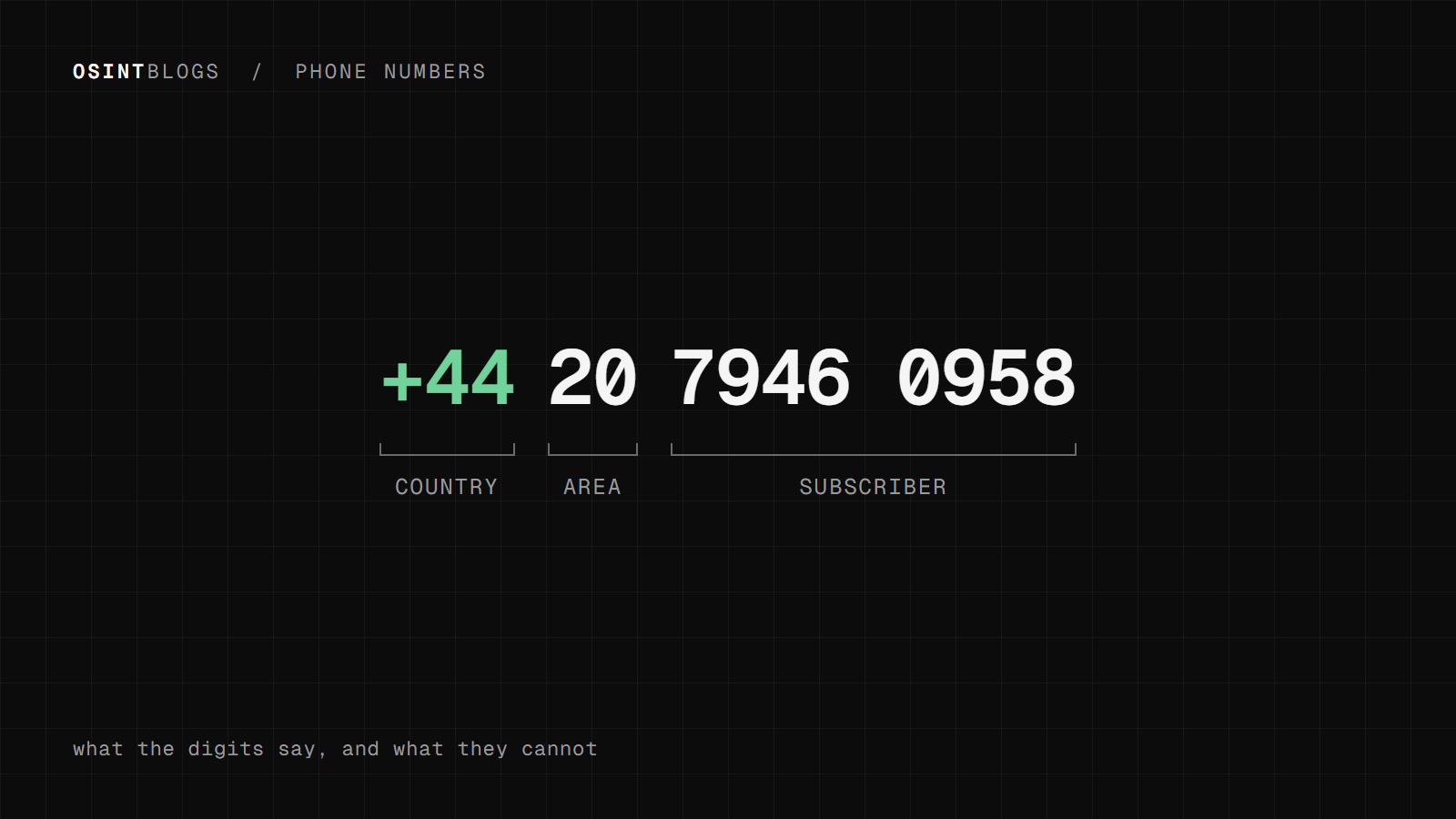
International numbers follow the E.164 standard: a plus sign, a country code of one to three digits, and a national number, with no more than fifteen digits in total. From the digits alone you can establish three things.
Fact | Reliability | Notes |
|---|---|---|
Country or territory | High | From the country code. Shared codes such as +1 need the area code as well |
Number type | High in most countries | Mobile, landline, toll-free, premium-rate or VoIP ranges are published in national numbering plans |
Original carrier and region | Medium | The operator the range was first allocated to. Wrong if the number has been ported |
Google's libphonenumber library holds this data and is the engine behind most "free phone lookup" tools. You can use it directly:
import phonenumbers
from phonenumbers import carrier, geocoder, number_type

number = phonenumbers.parse("+442079460958")
print(phonenumbers.is_valid_number(number))        # True or False
print(number_type(number))                         # 0 = fixed line, 1 = mobile, ...
print(geocoder.description_for_number(number, "en"))
print(carrier.name_for_number(number, "en"))
Two cautions apply to everything in that output:
Number portability. In most countries a customer can keep their number when changing operator. The carrier name from a prefix lookup is the original allocation, not necessarily the current network.
Geography is about allocation, not location. A landline area code says where the number was issued. A mobile number says nothing about where the handset is. In the United States, mobile numbers have area codes too, and people keep them when they move across the country.
A validity check only confirms that the number fits the country's numbering plan. It does not mean the number is in service.
Is the number in service, and on which network?
An HLR lookup answers this. Mobile networks keep a Home Location Register of their subscribers, and commercial services will query it for a fraction of a cent. The reply typically shows whether the number is active, the network currently serving it, whether it has been ported and sometimes whether the handset is roaming.
This is a paid, commercial source rather than a free one. It queries live network signalling about a subscriber, and whether you may use it depends on your purpose and your country's rules. It is routinely used for fraud prevention and for cleaning contact lists. It does not return a name.
VoIP and virtual numbers
Identifying a number as VoIP or virtual is often the most useful single finding, because it changes how much weight the number carries. Virtual numbers can be bought online in minutes, for any country, with little or no identity check. A "local" number on a business website may be a forwarding service, and a number used for a scam call is very often virtual and already abandoned.
Caller ID can also be spoofed. The number shown on an incoming call is supplied by the caller's side and may have nothing to do with the line really used. If the question is "who called me from this number?", the answer may be that nobody at that number did.
Finding where the number has been published
This is where open sources do real work. Businesses, sole traders, clubs and classified adverts publish phone numbers, and those pages are indexed.
The difficulty is formatting. The same number is written many ways, and search engines treat each as different text. Search for all of them, in quotes:
"+44 20 7946 0958"
"+442079460958"
"020 7946 0958"
"02079460958"
"(020) 7946 0958"
"7946 0958"
Add context when you have it, such as a town or trade, and try more than one search engine. The Google dorks cheat sheet covers operators that help, such as limiting results to classified-ad or social sites. Useful places for a number to appear include:
Business listings and maps. A number attached to a named business with an address and reviews.
Company and charity filings, planning applications, tender documents. Official documents with contact details.
Classified adverts and marketplaces. These often connect a number to a first name, a town and items for sale.
Archived pages. Old versions of a contact page can connect a number to a previous business or owner.
Domain registration records. Mostly redacted since 2018, but historical records sometimes include a phone number.
Tools such as PhoneInfoga automate the first steps: they parse the number, report its type and carrier, and generate search queries for you to open. PhoneInfoga's own documentation is clear that it does not identify the owner. That honesty is a good benchmark for judging other tools.
Messaging apps and caller ID apps
Messaging apps. Saving a number to a phone's contacts and opening WhatsApp, Telegram, Signal or Viber shows whether the number has an account, and, depending on the owner's privacy settings, a profile photo, display name and status. This works because the apps are built for contact discovery.
It is also where care is needed. Use a dedicated research device or account, never your personal one, because contact sync works both ways and some apps can suggest your account to the other person. A profile photo is a lead to verify with a reverse image search, not an identification. And check the terms of the service and your own organisation's rules before making this a routine step.
Caller ID apps. Truecaller and similar services return a name for many numbers. The names come largely from the address books of the app's users, so what you see is how someone saved that number: "Dave Plumber", "Mum", "DO NOT ANSWER". It is crowdsourced, sometimes wrong, sometimes out of date after a number is reassigned, and built on contact data that the people listed did not volunteer. Treat a result as a hint about how the number is known, and corroborate it elsewhere.
In the United States, landline and some mobile numbers have a CNAM record, which is the caller name shown on incoming calls. Commercial lookups query it. Coverage outside North America is poor.
What you cannot get from open sources
The subscriber's name and address. Held by the carrier. Released to law enforcement under legal process, and to nobody else.
Call and message records. The same.
Live location. Held by the network. Websites that claim to track a phone by number are scams or malware.
People do obtain these things by deception, by calling the carrier and pretending to be the customer. That is illegal. In the United States it is a federal crime under the Telephone Records and Privacy Protection Act of 2006, and elsewhere it falls under fraud and data protection offences. It is not OSINT.
Why reverse lookup sites disappoint
Search any number and you will find sites offering a full report. Most follow one pattern: a free "scan" with a progress bar, a teaser claiming records were found, then a subscription page. The underlying data is usually marketing lists and scraped directories, matched loosely. Outside the United States, where commercial data brokers have less to work with, the reports are often empty.
A few signs help you judge a source: does it say where its data comes from, does it show how old a record is, and does it return "nothing found" for a number you know to be unlisted? A service that finds something for every number is making it up.
A sensible workflow
Normalise the number to E.164 and list its written variants.
Parse it: country, type, original carrier. Note if it is VoIP or virtual.
Search each variant in quotes, across engines and archives.
Check the context of every hit. Who published the number, when, and in what role?
Corroborate. A business listing, a company filing and an archived contact page that agree are a finding. A single caller ID name is not.
Record what you verified, what you inferred, and what you could not establish.
If the number connects to an email address or a username along the way, those are far more productive to research. See our guides to email OSINT and username OSINT.
Frequently asked questions
Can I find out who owns a phone number for free?
Only if the owner, or someone else, has published the number alongside a name: a business listing, an advert, a public profile. For private mobile numbers that have never been published, open sources will not give you the owner.
Can a phone number be traced to a location?
Not by the public. The number shows the country and, for landlines, the area where it was issued. A mobile's real-time location is known to the network and available only through legal process or to emergency services.
Is it legal to look up a phone number?
Searching for a number in public sources is legal in most countries. Obtaining subscriber records by deception is a crime, and storing or sharing personal data you find is subject to data protection law.
How can I tell if a number is VoIP?
A numbering-plan lookup, such as libphonenumber, identifies ranges allocated for VoIP in countries that separate them. Where they are not separated, a carrier lookup that returns a VoIP provider is the usual indicator.