OSINT due diligence: a proportionate checklist for third parties
How to run open-source due diligence on a supplier, partner or client without drowning in false positives. Risk tiering, the checks for each tier, sanctions and politically exposed person screening, adverse media search strings, telling namesakes apart and recording the decision.

· 7 min read
Due diligence is checking who you are about to do business with, before you do it. Regulators expect it of banks and law firms. Anti-bribery and sanctions laws effectively require it of everyone else. And plain commercial sense requires it of any firm that pays invoices.
Most of it can be done with open sources. The hard part is proportion: doing enough for the risk, and coping with the flood of irrelevant matches that name searches produce. This guide sets out a tiered approach that a small team can run.
Start with the risk, not the search
Not every counterparty deserves the same effort. Sort them first.
Factor | Lower risk | Higher risk |
|---|---|---|
Country | Strong rule of law, transparent registries | High corruption indices, sanctions exposure, secrecy jurisdictions |
Sector | Regulated, low cash | Defence, extractives, construction, gambling, crypto, intermediaries |
Role | Supplier of standard goods | Agent or consultant acting on your behalf, especially with officials |
Value and duration | Small, one-off | Large, long-term, exclusive |
Ownership | Listed company, clear owners | Opaque chains, nominee directors, trusts |
How they came to you | Established relationship | Recommended by an official, insists on urgency |
Payment | To the company, in its own country | To a third party, to another country, in cash or crypto |
A sensible scheme has three tiers: basic checks for everyone, standard checks for most ongoing relationships, and enhanced checks where several higher-risk factors appear. Write the criteria down, so the tier is a rule and not a mood.
Tier 1: basic checks
About fifteen minutes. For every new counterparty.
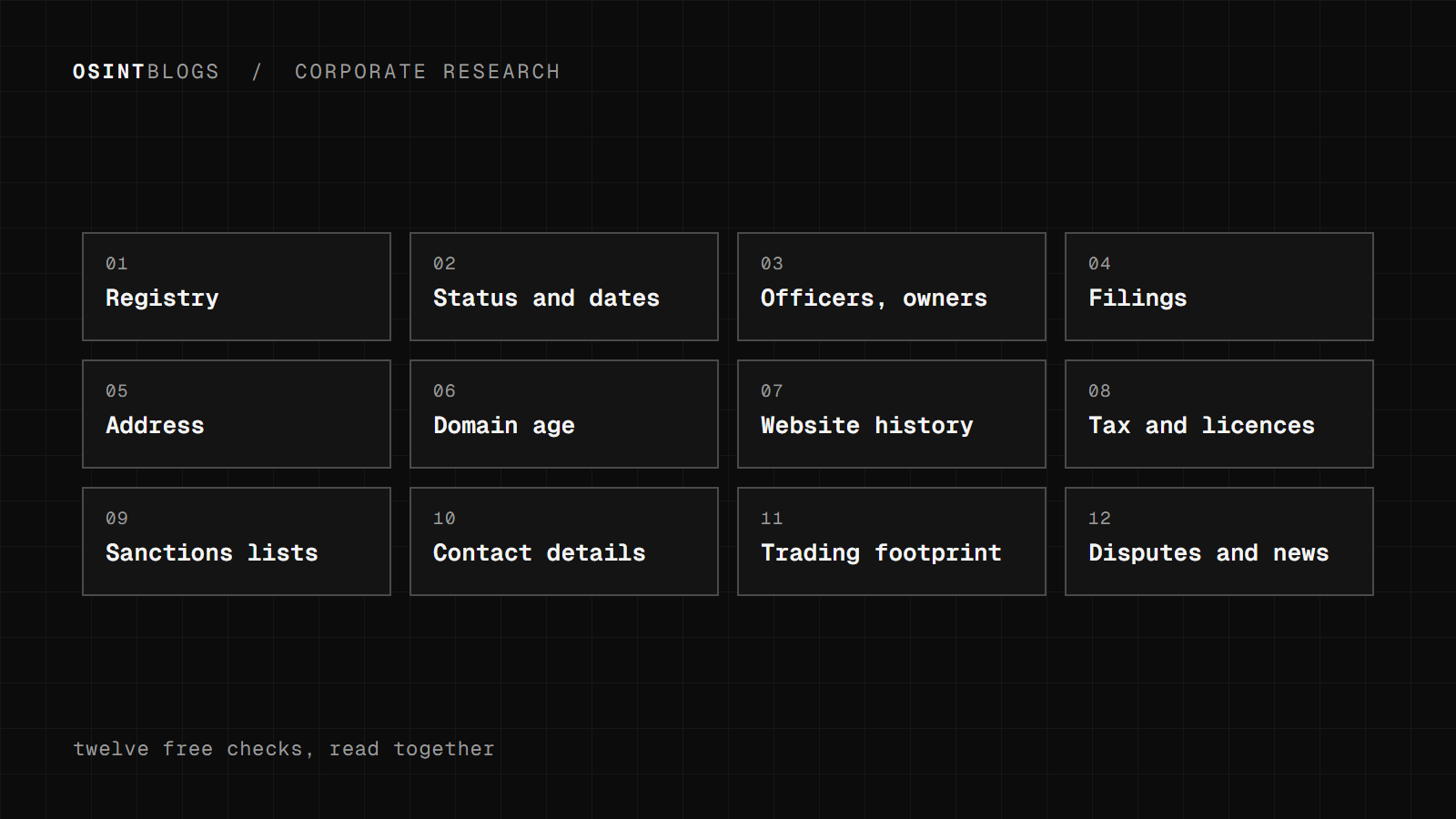
Confirm legal existence in the official registry, by registration number. Note status and incorporation date.
Match the details you were given against the registry: name, address, directors.
Screen the entity against sanctions lists.
Confirm the bank account is in the company's name and country.
Run a quick search of the name with a few risk terms.
Our guide to checking whether a company is legitimate covers these in detail.
Tier 2: standard checks
One to two hours. Adds the people and the history.
Ownership and control
Identify the directors and the beneficial owners, meaning the individuals who ultimately own or control the company, commonly those with 25 per cent or more. Sources: the company registry, beneficial ownership registers where public, annual reports, stock exchange filings and the company's own disclosures.
Follow the chain upwards until you reach people or a listed company. Where the chain disappears into a jurisdiction that publishes nothing, record that it does. Then ask the counterparty for a signed ownership declaration, and treat a refusal as a finding.
Sanctions and politically exposed persons
Screen the company, its directors and its owners.
Sanctions lists: the US Treasury's OFAC list, the UK sanctions list, the EU consolidated list and the UN list, all searchable free. Consider any others relevant to where you operate.
Ownership rules: entities owned 50 per cent or more by sanctioned persons are generally treated as sanctioned too, even when not named. This is why ownership comes first.
Politically exposed persons: senior officials, their close relatives and associates. They are not prohibited counterparties. They carry higher bribery risk and call for more scrutiny of where money comes from.
Aggregated data: OpenSanctions combines sanctions, political office and other watchlists into one searchable set, free for non-commercial use.
Names are transliterated in many ways. Use the lists' own fuzzy matching, try spelling variants, and compare dates of birth, nationalities and addresses before deciding a match is or is not your subject.
Adverse media
Search for negative news about the company and each key person. Build the search string once and reuse it:
"Company Name" AND (fraud OR bribery OR corruption OR "money laundering" OR sanctions OR investigation OR lawsuit OR convicted OR fine OR insolvency)"Firstname Lastname" AND ("Company Name" OR "City") AND (fraud OR bribery OR corruption OR arrested OR charged OR convicted OR banned)Practical points:
Search in the local language and script as well as English. Most adverse coverage of a regional company is in regional media.
Use more than one search engine, and a news archive if you have one.
Add an identifier. A city, employer or middle name cuts irrelevant results sharply.
Go back at least ten years, and note the date range you covered.
Read the source. A blog repeating a rumour and a court report are different things. Grade them.
Follow the story to its end. An arrest reported in 2019 may have ended in acquittal in 2021. Reporting the first without the second is unfair and misleading.
See our Google dorks cheat sheet for operator details.
Litigation, insolvency and regulatory records
Check, where public: court judgments and case lists, insolvency registers, disqualified director registers, regulators' enforcement notices and debarment lists such as the World Bank's list of ineligible firms.
Track record
Does the business have the history and capacity it claims? Filed accounts, staff numbers, premises, age of the website and domain, customer references you can verify independently, and a footprint in trade press. See LinkedIn OSINT for reading headcount and staff claims.
Tier 3: enhanced checks
Hours to days. For the highest risks, in addition to everything above.
Full ownership map, including indirect holdings and related companies of each owner.
Source of wealth for the principal owners: how did they come to have the money?
Associates. Business partners, family members in public office, former companies and what became of them.
Reputation in the market, through discreet enquiries with people who know the sector.
Site or premises verification, by visit or by imagery.
Deeper media and records research in each relevant country and language, possibly with local help.
Specialist sources: leaked corporate records published by journalism consortia, shipping and aircraft records for firms with such assets, and public procurement databases.
At this level, structured methods help keep the analysis honest. See OSINT pivoting for mapping links and Analysis of Competing Hypotheses for testing explanations.
Resolving false positives
A search for a common name returns hundreds of results about other people. Clearing them is most of the work, and doing it badly either wastes days or smears an innocent person.
For each potential match, compare identifiers:
Identifier | Strength |
|---|---|
Date of birth, full | Strong |
Unique registration or officer number | Strong |
Full name including middle names, plus city | Good |
Photograph matching a confirmed image | Good |
Employer or company named in the article | Good |
Age and nationality | Moderate |
Name and country only | Weak |
Then record the decision in a line:
Confirmed match: two or more strong or good identifiers agree.
Discounted: at least one identifier clearly conflicts, such as an age twenty years out.
Unresolved: not enough to decide. Say so, and consider asking the counterparty directly.
Never discount silently and never include an unresolved match as if it were confirmed. The written reason is what an auditor or regulator will ask to see.
Red flags
No single flag disqualifies. A cluster calls for enhanced checks or a decision to walk away.
Reluctance to identify owners or provide documents
Ownership that changed shortly before the deal
A newly formed company for a large contract
Fees out of proportion to the service described
Payment requested to a different entity or country
An agent whose main qualification is a relationship with an official
A director with a string of dissolved companies
Addresses, phone numbers or directors shared with a sanctioned or discredited entity
Credible adverse media that the counterparty did not mention
Pressure to skip the process
Fairness and data protection
Due diligence involves collecting personal data about directors and owners, including allegations about them.
Have a lawful basis. Legal obligations and legitimate interests usually apply. Criminal allegation data needs extra care under EU and UK law.
Stay relevant. Business conduct is in scope. Private life, health, religion and family are not, unless directly connected to the risk.
Be accurate. Record outcomes, not only accusations, and note the reliability of each source.
Give a chance to respond before an adverse decision, where you can.
Retain for a defined period and restrict access.
See our overview of whether OSINT is legal.
Record the decision
The output is a short, dated file that someone else could review:
Who was checked, and at which tier, with the reason for the tier.
What was searched, where, on what date, with which search terms.
Findings, each with its source and a reliability grade.
Potential matches and how each was resolved.
Gaps: what could not be checked.
The risk assessment and any conditions, such as contract clauses or enhanced monitoring.
The decision, who made it and when.
The date of the next review.
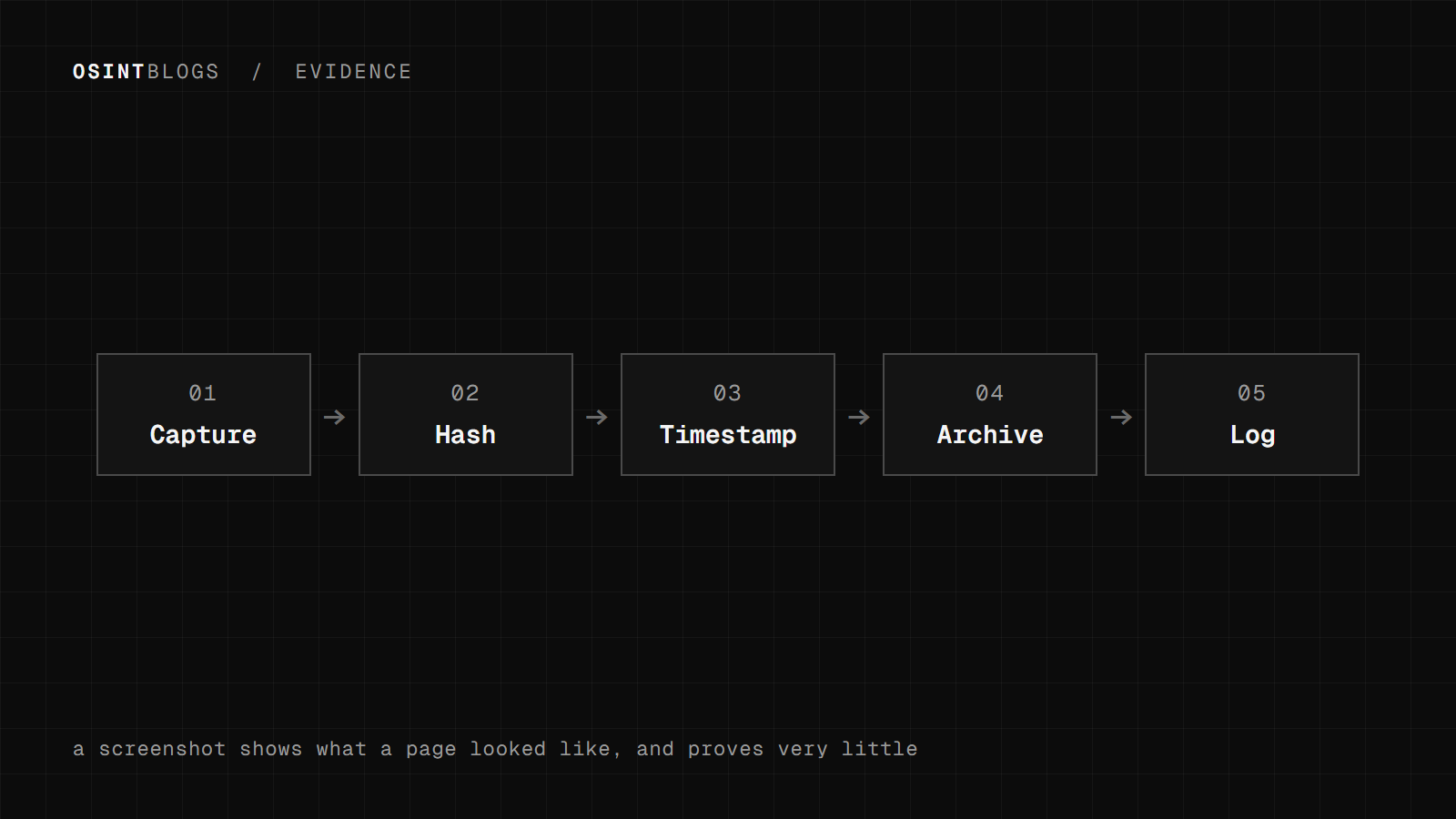
Our OSINT report template can be adapted, and preserving web evidence covers keeping the sources.
Due diligence is not a single event. Ownership changes, sanctions lists are updated daily, and news breaks. Re-screen periodically, more often for higher tiers, and whenever something about the relationship changes.
Frequently asked questions
What is OSINT due diligence?
Using publicly available sources, such as registries, sanctions lists, court records and news, to check the identity, ownership, integrity and track record of a business or person before entering a relationship.
What is adverse media screening?
Searching news and other public sources for negative information linking a person or company to crime, corruption, sanctions or other serious misconduct.
How do I reduce false positives in name screening?
Add identifiers to the search, such as a city or employer, and compare dates of birth, addresses and photographs before accepting a match. Record why each non-match was discounted.
What is a politically exposed person?
Someone who holds or recently held a prominent public position, and their close family and associates. They present a higher risk of involvement in bribery and corruption, and call for closer scrutiny.
How often should due diligence be repeated?
Periodically, by risk tier, with higher-risk relationships reviewed at least yearly, and whenever ownership, activity or circumstances change. Sanctions screening should be ongoing.