OSINT pivoting: how to get from one identifier to the next
Pivoting is how an investigation moves from one known fact to the next. A pivot map for emails, usernames, phone numbers, domains, IP addresses and images, how to rate each link, the false connections that catch people out, and when to stop.

· 8 min read
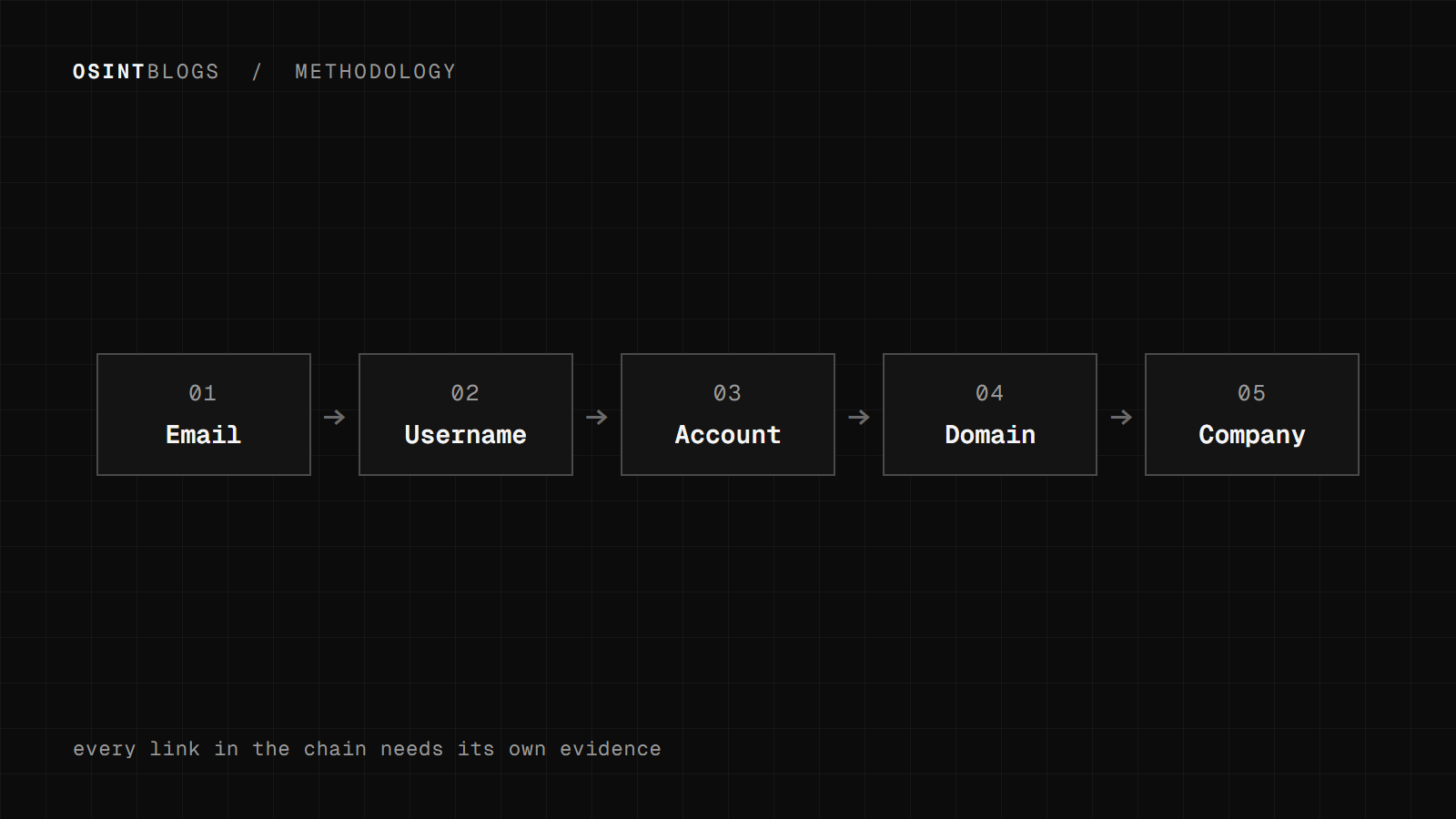
Almost every open-source investigation starts with one thing: an email address on an invoice, a username on a forum, a domain in a phishing message. Pivoting is the step of using that one identifier to find another, then using the new one to find a third, until the chain reaches something that answers the question.
It is the central skill of the field, and the place where most wrong conclusions are made. Each step is a claim that two things belong to the same person or organisation. This guide covers where the steps come from and how to judge them.
Selectors and pivots
A selector is any identifier you can search on: an email address, username, phone number, name, domain, IP address, image, wallet address, company number or document.
A pivot is a move from one selector to another through some source that connects them. Every pivot has three parts:
the selector you started from
the selector you arrived at
the evidence that links them
Analysts who record the first two and forget the third end up with a diagram of connected dots and no means of defending any line in it.
A pivot map
From | To | Through |
|---|---|---|
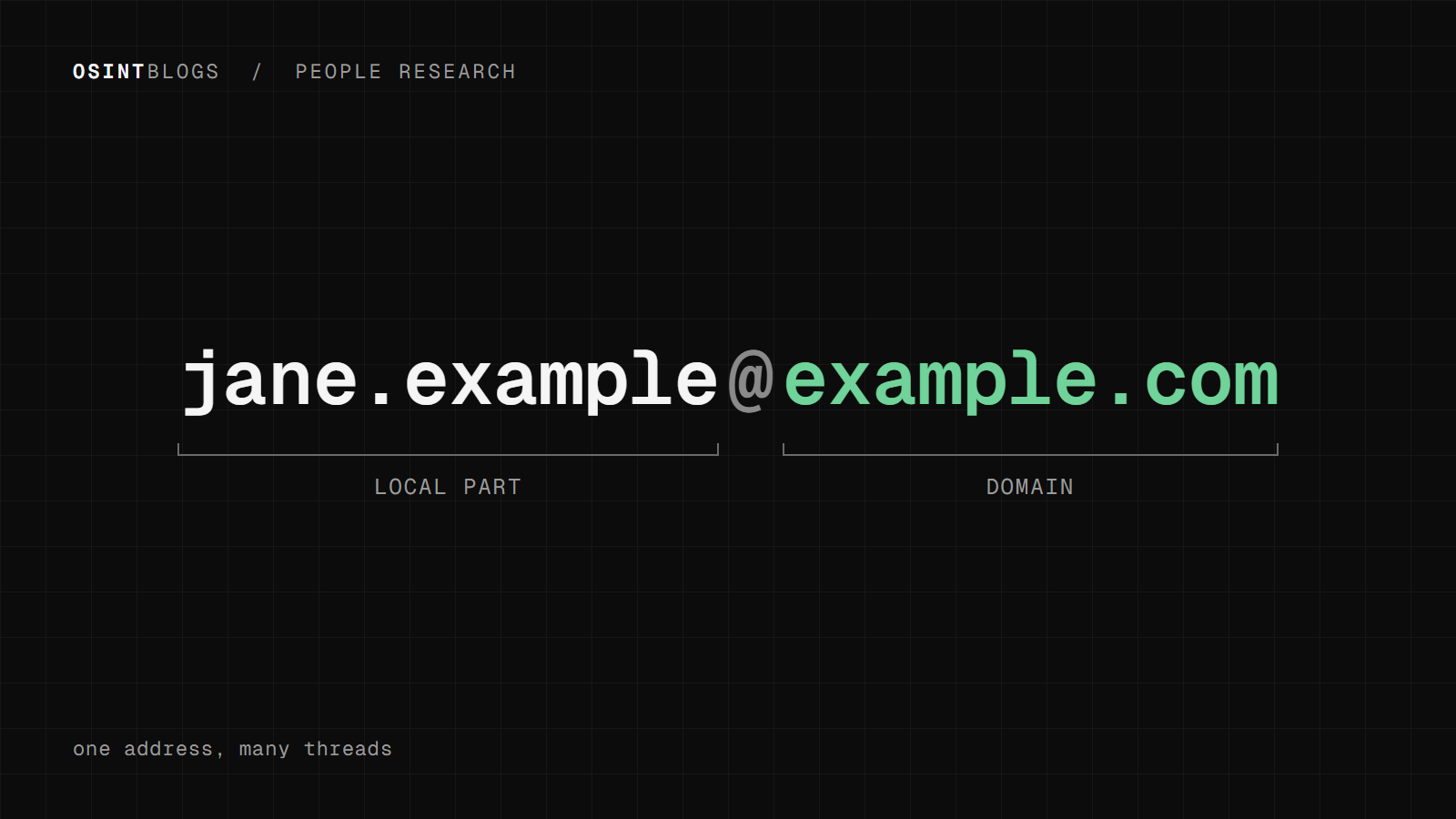
Email address | Username | The part before the |
Email address | Domain | The part after the |
Email address | Accounts on platforms | Account-existence checks, profile lookups |
Email address | Name, photo | Avatar services, document metadata, public profiles |
Username | Other platforms | Username search across sites |
Username | Email address | Code commits, public profiles, forum posts |
Phone number | Name, accounts | Messaging app profiles, caller ID services, business listings |
Name | Company roles | Company registries, professional networks |
Domain | Registrant, related domains | Registration records, name servers, certificates, tracking IDs |
Domain | IP address, host | DNS records, passive DNS |
IP address | Other domains | Reverse and passive DNS, scan data |
Image | Other accounts, earlier uses | Reverse image search |
Document | Author, software, organisation | File metadata |
Wallet address | Other wallets, exchanges | Public blockchain transactions |
Each row has a guide of its own on this site: email, username, phone number, domain, IP address, images and GitHub.
Not all links are equal
The strength of a pivot depends on how many other people or organisations could produce the same link.
Strength | Kind of link | Example |
|---|---|---|
Strong | Unique and hard to share or fake | The same SSH key on two accounts. A domain handle verified by DNS. An account that links to another, which links back |
Good | Unique identifier reused | The same uncommon email address on two registrations. The same analytics ID on two websites |
Moderate | Distinctive but not unique | The same unusual username on two platforms, with matching interests. The same profile photo |
Weak | Shared by many | The same common username. The same IP address on shared hosting. The same first name and city |
None | Coincidence dressed as a link | Two accounts that follow the same celebrity. Two sites using the same popular template |
Useful questions for any link:
How many others share this? A username like
alex92has thousands of owners. One likequietheron_devprobably has one.Who controls the evidence? A registry record or a platform-verified link is controlled by a third party. A bio that says "also on X as..." is controlled by whoever wrote it, which may be an impersonator.
Does the link run both ways? A profile claiming to be a company's official account is a claim. The company's website linking to that profile is confirmation.
Do the times fit? Two accounts linked by a phone number are only linked if the same person held the number at both dates.
False links that catch people out
Common usernames. The most frequent error in the field. Matching usernames need supporting detail before they count: the same photo, the same niche interests, the same writing habits, the same city.
Recycled phone numbers. Carriers reassign numbers after a period of disuse. An account registered to a number in 2019 may belong to its previous holder.
Recycled and expired email addresses. Some providers release dormant addresses, and expired domains can be re-registered by anyone, who then receives the mail.
Shared infrastructure. Thousands of unrelated sites share one address on shared hosting or a content delivery network. Shared name servers at a large registrar mean nothing.
Privacy services. Every domain using the same privacy service shows the same registrant details.
Shared devices and connections. A household, an office or a café produces many people behind one IP address.
Namesakes. Two people with the same name in the same city are common. Match on a second attribute such as age, employer or a photo.
Deliberate false trails. People who expect to be investigated plant other people's details. A link that is too neat deserves a second look.
Stale data. A breach record or cached page describes a moment in the past.
Tool errors. Username checkers report accounts that do not exist, because sites answer unknown names in inconsistent ways. Open every reported profile yourself.
Keeping the chain honest
Record each pivot as you make it. One row per step:
Field | Example |
|---|---|
Step | 4 |
From | Username |
To | Email address in commit headers |
Evidence | Commit dated 12 May 2023, captured as E-007 |
Strength | Good. Address appears in 40 commits over two years |
Alternative explanation | Commits authored by a colleague using the same repository |
Checked by | Second address found in the profile's public key |
Two rules keep the record meaningful.
A chain is as strong as its weakest link. If step 3 is a weak username match, everything after step 3 inherits that weakness, however solid steps 4 to 9 are. Mark it in the diagram and say it in the report.
Look for a second, independent path. If you reached a conclusion through one chain, try to reach it through a different one. A person identified through a username chain, and separately through a domain registration chain, is far better supported than either alone. Converging paths are what move a finding from possible to probable.
For how to grade sources and word your confidence, see our OSINT report template.
Breadth first, then depth
At each selector you could pivot in several directions, and the number of leads grows quickly. A workable discipline:
List the pivots available from the current selector before following any.
Rank them by likely strength and by relevance to the question.
Follow the best one or two. Park the rest in a list.
Confirm before going on. A weak link confirmed by a second attribute is worth more than three further hops built on it.
Come back to the parked list when a line runs dry.
Without this, investigations drift. You start on a fraudulent invoice and find yourself, three hours later, reading the forum posts of someone who shares a username with the fraudster's cousin.
When to stop
Stop pivoting when one of these is true:
The question is answered to the confidence the decision needs.
The next step needs non-public access, such as a login, a subscriber record or a private group. That is the boundary of open-source work. See our overview of whether OSINT is legal.
You are collecting about people outside the question. Family members, colleagues and namesakes appear in every investigation. Unless they are part of the answer, leave them out of your notes.
The remaining links are all weak, and further hops would only add speculation.
You have hit the limits you set at the start for time and scope.
Stopping with "not established" is a legitimate result. Report how far the chain went and where it broke.
A worked example
A finance team receives an invoice from accounts@example-supplies.com, a domain one word away from a real supplier's.
Email to domain. The domain was registered eleven days ago. Strong, from registry data.
Domain to related domains. Its name servers and registration time match two other domains registered the same hour, each imitating a different supplier. Good: three attributes agree.
Domain to IP to other domains. The hosting address is a large shared platform. Weak. Parked.
Domain to website. The site copies the real supplier's pages and carries an analytics ID. The same ID appears on the two sister domains and on a fourth site. Good.
Fourth site to username. The fourth site is a small web design portfolio with a contact username. Moderate: the ID shows the same analytics account, which could belong to a hired developer.
Username to other platforms. The username is distinctive and appears on a freelance marketplace with the same portfolio images. Moderate to good.
What can be reported: the invoice came from a newly registered lookalike domain, which is one of at least three run together. It is likely that a specific web design account built or manages the sites. Whether that person runs the fraud, or was hired by whoever does, is not established. That distinction is the difference between a useful report and an accusation.
Frequently asked questions
What is pivoting in OSINT?
Moving from one identifier to another through a source that connects them, such as from an email address to the username it contains, and from that username to accounts on other platforms.
What is a selector in OSINT?
Any identifier that can be searched: an email address, username, phone number, domain, IP address, name, image or wallet address.
How do I know if two accounts belong to the same person?
Look for unique shared attributes, links that run in both directions, consistent details across both, and ideally a second independent chain leading to the same conclusion. A matching username alone is not enough.
What is the most common mistake in OSINT pivoting?
Treating a weak link, usually a common username or a shared IP address, as proof, and then building further conclusions on it.
How many pivots are too many?
There is no number, but every hop adds uncertainty. If a conclusion rests on a long chain with one or more weak links and no second path, report it as a lead and not as a finding.