How to check if a company is legitimate: 12 open-source checks
Twelve free checks that show whether a business exists, who is behind it and whether it really trades. Registry records, officers and owners, filings, addresses, domain age, website history, email set-up, tax numbers, sanctions lists, reviews and litigation.

· 8 min read
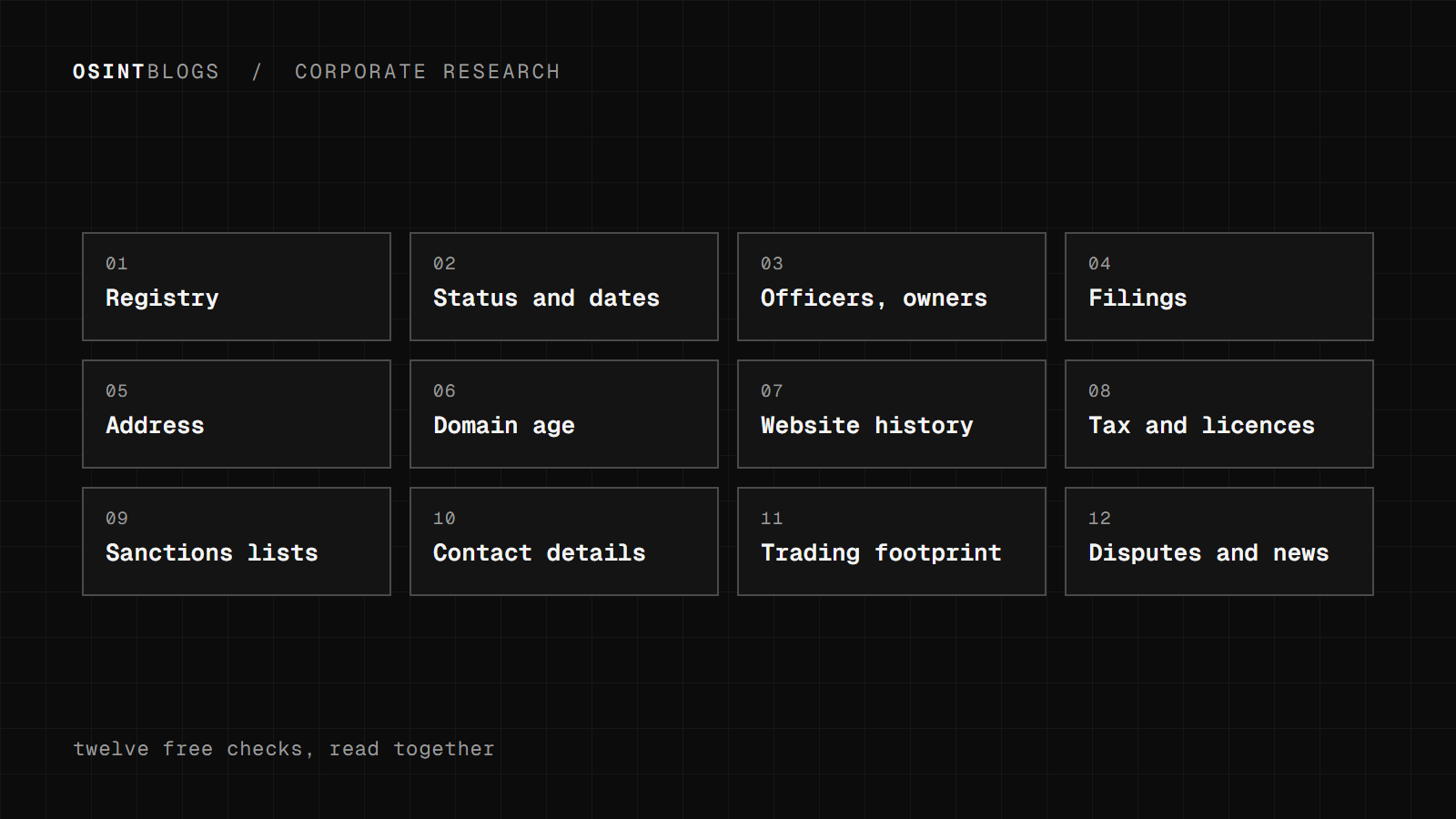
A website, a logo and an invoice template cost almost nothing. A company that has existed for eight years, filed accounts, employed people and left traces across independent records is much harder to fake. Checking whether a business is legitimate means looking for those traces, and noticing where they are missing or contradict one another.
The twelve checks below use free public sources. Together they take about an hour for a simple case. None is decisive alone. The picture comes from how they fit.
What you are trying to establish
Question | Checks |
|---|---|
Does the company legally exist? | 1, 2, 8 |
Who runs and owns it? | 3, 4 |
Is it where it says it is? | 5 |
Has it existed as long as it claims? | 2, 6, 7 |
Does it actually trade? | 4, 10, 11 |
Is there a reason not to deal with it? | 9, 11, 12 |
Start by writing down exactly what the company has told you: legal name, registration number, address, directors, founding year, website, email address, phone number and tax number. Every check compares one of those claims with an independent record.
The checks
1. Find it in the official registry
Every legitimate company is registered somewhere. Go to the registry of the country or state it claims, not to a link the company supplies.
United Kingdom: Companies House, free and detailed.
United States: the Secretary of State for the state of incorporation. Delaware gives little for free. Companies that sell securities file with the SEC on EDGAR.
European Union: national registers, linked through the European e-Justice portal's business register search.
Many countries at once: OpenCorporates aggregates registries worldwide and is a quick way to find which register to consult.
Larger entities: the GLEIF database of Legal Entity Identifiers, which also records parent companies.
Match the registration number, not only the name. Fraudsters register names almost identical to real firms, or simply borrow a real firm's name and number.
2. Read the status and the dates
The record shows whether the company is active, dormant, in liquidation or dissolved, and when it was incorporated. Compare the incorporation date with the history the company tells. "Twenty years of experience" from a company incorporated last spring needs an explanation, such as a predecessor business you can also check.
Look at the history of names. A recently renamed company may be distancing itself from a past.
3. Look at the officers and owners
Registries list directors, and many list beneficial owners. For each person:
Other appointments. One click in most registries. A director with forty current companies, or a trail of dissolved ones, is a pattern to understand.
Appointment dates. A whole board replaced last month suggests the company was bought off the shelf or taken over.
Disqualification. The UK and several other countries publish registers of disqualified directors.
Existence. Do the directors appear anywhere else as real people with a professional history? Our guide to LinkedIn OSINT covers how to read profiles critically.
Ownership chains. An owner that is another company in a secrecy jurisdiction is not proof of wrongdoing. It does mean you do not know who you are dealing with.
Registries mostly record what they are told. Until recently, UK filings were accepted without identity checks, and false names were filed. Treat registry data as a claim made under legal penalty, which is better than a website and short of proof.
4. Read the filings
Accounts and annual returns show whether the company's size matches its claims.
A business quoting for a large contract while filing accounts for a dormant or micro company is not the size it suggests.
Overdue accounts and warnings of strike-off are signs of neglect or distress.
Registered charges show who has lent it money against its assets.
Changes of registered office every few months suggest a company staying ahead of its mail.
5. Check the address
Search the registered and trading addresses on a map and in street-level imagery.
Serviced offices and mailbox addresses are normal for small firms. They do mean the address shows nothing about substance.
A residential address is common for sole directors and tells you the scale.
Hundreds of companies at one address means a formation agent. Search the address in the registry to see the neighbours.
A claimed factory or warehouse should be visible from above. A claimed shop should be visible from the street.
6. Check the domain's age and ownership
Fraudulent shops and suppliers usually operate from recently registered domains.
curl -sL https://rdap.org/domain/example.com | jq '.events[] | {eventAction, eventDate}'Compare the registration date with the claimed founding year. A long-established firm can have a new domain after a rebrand, in which case there should be an older one that redirects. Our guide to investigating a domain covers registration records, hosting and related sites.
7. Look at the website's history
The Wayback Machine shows what a site looked like in earlier years. A real business leaves an ordinary trail: an older design, earlier products, former staff. Warning signs are no captures before this year, or a domain that hosted something unrelated until recently.
Check the content too. Copy a paragraph of the "About us" text and a staff photo into a search engine. Fake firms copy text from real ones and use stock or stolen photos for their team. See our guide to verifying an image.
8. Verify tax and licence numbers
EU VAT numbers can be validated in the European Commission's VIES system, which returns the registered name and address for most member states.
UK VAT numbers can be checked with HMRC's online service.
Regulated activities have public registers: financial firms, law firms, insurers, gambling operators, pharmacies, security companies and many trades. If the company claims a licence, look it up on the regulator's own register and compare the details. Regulators also publish lists of unauthorised firms and clones.
9. Screen against sanctions lists
Check the company, its directors and its owners against the main lists: the US Treasury's OFAC list, the UK sanctions list and the EU consolidated list. All have free search pages. Names are transliterated in many ways, so use the fuzzy search options and compare dates of birth and addresses before concluding a match or a miss. Ownership matters as well as names, since entities owned by sanctioned persons are commonly covered.
10. Test the contact details
Email. A business that writes from a free webmail address, or from a domain that differs by a character from its website, deserves suspicion. Check that the domain has mail records. See email OSINT.
Phone. Is the number a landline in the claimed area, a mobile or an internet number? See phone number OSINT.
Bank details. The account name should match the legal entity, and the bank's country should make sense. A change of bank details by email is the commonest route for invoice fraud. Confirm by phone using a number from an independent source.
11. Look for a trading footprint
Real businesses are noticed by others.
Reviews spread over years, on more than one platform, in varied language. A burst of five-star reviews in one week is manufactured.
Mentions in trade press, tender awards, court lists, job adverts and customers' websites.
Social media accounts with a history. See the platform guides on this site.
Import and export records, trade mark registrations and patents, where relevant.
A complete absence of independent mentions is unusual for any business that has traded for more than a year or two.
12. Search for disputes and adverse news
Search the company and director names with words such as fraud, scam, lawsuit, insolvency, investigation and complaint, in the local language as well as English. Check insolvency registers and court judgment databases where they are public. Read what you find for specifics and dates, and make sure it concerns the same entity and not a namesake.
Reading the results together
Pattern | Likely meaning |
|---|---|
Registered, long history, filings match claimed size, independent mentions | Ordinary legitimate business |
Real registered company, but contact details and domain differ from its official ones | Someone is impersonating a real firm |
Recently formed, new domain, formation-agent address, claims of long history | Shell created for a purpose. High risk |
Real but dormant company with new directors and a new website | Aged shell bought to appear established |
Legitimate and active, with overdue filings and court judgments | Genuine business in financial trouble |
The second row is the one people miss. Checking that "Example Trading Ltd" exists proves nothing if the person emailing you has no connection to it. Always confirm through a channel you found yourself, such as the phone number on the regulator's register or the company's long-standing website.
Keeping a record
Save the registry pages, dates and results as you go, and note the date of each check, since records change. A short written summary of what was checked, what was found and what could not be confirmed is what an auditor or a court will ask for later. See preserving web evidence and our OSINT report template.
Frequently asked questions
How can I check if a company is real for free?
Look it up by registration number in the official company registry of the country it claims, then compare the directors, address and incorporation date with what the company told you.
Is a registered company automatically legitimate?
No. Registration is cheap and, in many places, lightly checked. It shows a legal entity exists. Whether it trades honestly, or whether the person contacting you represents it, needs the other checks.
How do I know if a company website is fake?
Check the domain's registration date, look at its history in the Wayback Machine, search for its text and staff photos elsewhere, and compare its contact details with the registry and regulator records.
What is a shell company?
A company with no real operations or staff. Shells have lawful uses, such as holding assets, and are also used to hide ownership and commit fraud. Signs include a formation-agent address, nominee directors and no trading footprint.
What should I do if the checks do not add up?
Ask the company to explain the specific discrepancy and to provide documents you can verify independently. Do not send money or goods until it is resolved, and report suspected fraud to the relevant national reporting body.