Bluesky OSINT: DIDs, handle history and the open AT Protocol
Bluesky is built on an open protocol, so far more is public than on other networks. How to resolve a handle to its permanent DID, read handle history in the PLC directory, use the public API without a key, decode post times and understand which timestamps can be forged.

· 6 min read
Most social networks treat their data as a private asset and show researchers a little of it. Bluesky works the other way round. It runs on the AT Protocol, in which every account is a public, signed repository of records that anyone can read. Posts, likes, follows, lists and even blocks are open, and the main API needs no key.
For a researcher this is close to ideal, as long as you understand which parts of the record the platform vouches for and which parts the user controls.
The identifiers
Identifier | Example | Notes |
|---|---|---|
Handle |
| Can be changed at any time |
DID |
| Permanent account identifier |
Record key |
| Identifies one post within an account |
PDS | A server address | Where the account's data is hosted. Can move |
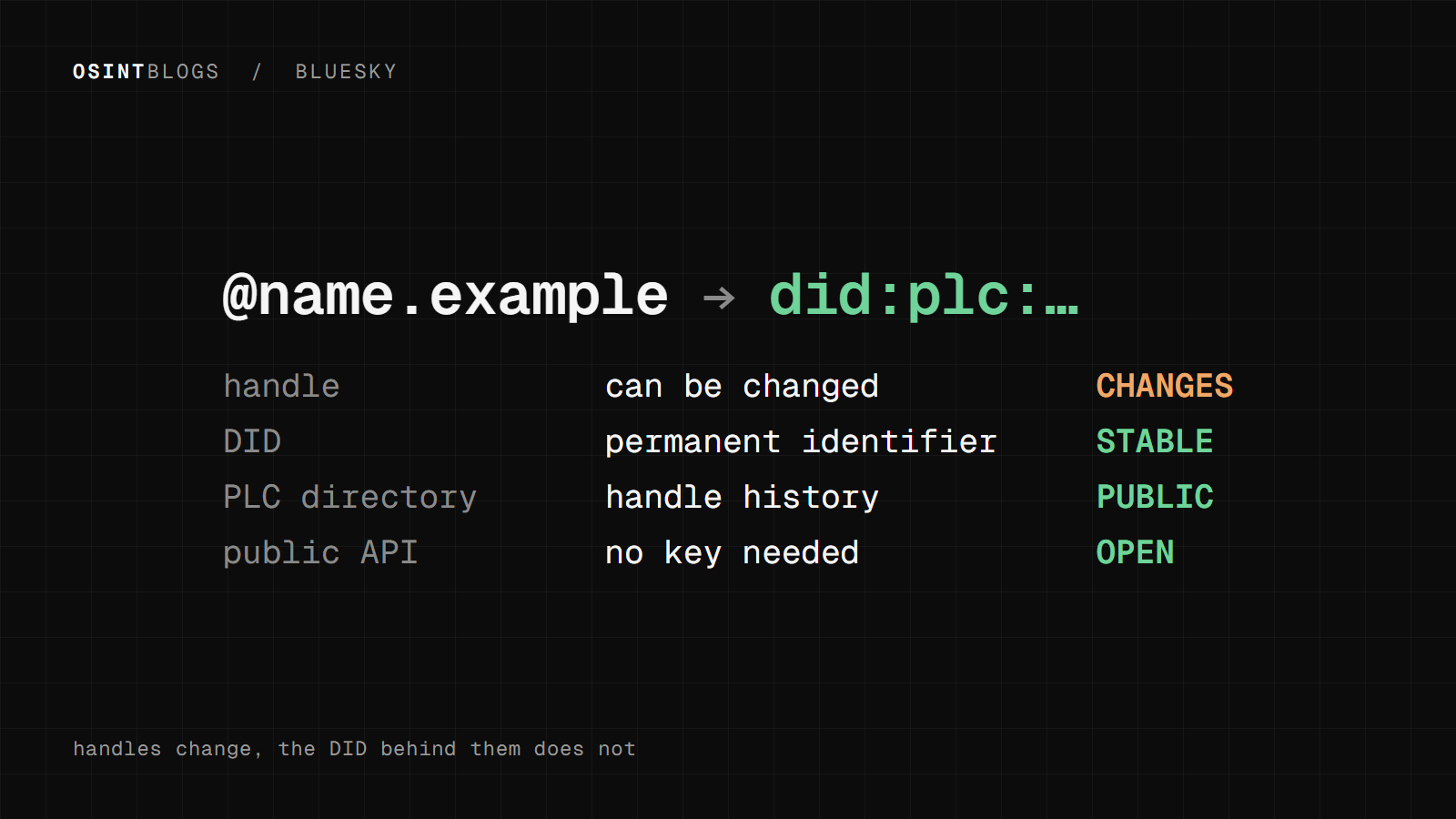
The handle is what people see. The DID is the account. Record the DID, and build links with it, because a link containing a DID survives any handle change:
https://bsky.app/profile/did:plc:abcdefghijklmnopqrstuvwx
https://bsky.app/profile/did:plc:abcdefghijklmnopqrstuvwx/post/3kabcdefghi2x
Resolve a handle and read the profile
No account or key is needed.
# Handle to DID
curl -s "https://public.api.bsky.app/xrpc/com.atproto.identity.resolveHandle?handle=example.bsky.social"

# Full profile
curl -s "https://public.api.bsky.app/xrpc/app.bsky.actor.getProfile?actor=example.bsky.social" | jq '{did, handle, displayName, description, createdAt, followersCount, followsCount, postsCount, labels}'
The profile includes counts, the description, any moderation labels applied to the account, and createdAt.
Handle history in the PLC directory
Most Bluesky accounts use a DID of the did:plc kind, registered in a public directory. Every change to the account's identity is logged there with a server timestamp: creation, each handle change and each move to a different host.
curl -s "https://plc.directory/did:plc:abcdefghijklmnopqrstuvwx/log/audit" | jq '.[] | {createdAt, handles: .operation.alsoKnownAs, pds: .operation.services.atproto_pds.endpoint}'This is the most valuable record on Bluesky for attribution:
The first entry is the account's creation, timestamped by the directory, not by the user.
Every handle the account has ever used is listed in order. An account now called
citynews.bsky.socialthat began as something unrelated has told you its history.The hosting server. Most accounts are on Bluesky's own servers. An account on an independently run server points to its operator, and server operators can see more than outsiders can.
A smaller number of accounts use did:web, where the identity document sits on a website the user controls. Those have no public audit log, and their history is whatever archives captured.
Domain handles are verified ownership
A handle that is a domain name, such as example.com, works because the account proved control of that domain. The proof is public and you can check it yourself:
dig +short TXT _atproto.example.com
curl -s https://example.com/.well-known/atproto-did
One of the two will return the account's DID. This is real evidence: whoever controls the DNS or the web server of that domain set up the link. A journalist with a handle under their employer's domain has been vouched for by that employer's infrastructure. From there, the domain itself is open to research. See our guide to investigating a domain.
It also cuts the other way. A convincing lookalike domain gives an impersonator a convincing handle, so read the domain character by character. Our guide to lookalike domains covers the tricks.
Bluesky also shows a blue check on accounts verified by Bluesky itself or by organisations it has approved as trusted verifiers. Clicking the check shows who issued it.
Reading posts and their timestamps
# Recent posts by an account
curl -s "https://public.api.bsky.app/xrpc/app.bsky.feed.getAuthorFeed?actor=did:plc:abcdefghijklmnopqrstuvwx&limit=50" | jq '.feed[].post | {uri, text: .record.text, createdAt: .record.createdAt, indexedAt}'
Each post has two times, and the difference between them matters.
createdAtis written by the user's app. It can be set to anything, and tools that import old posts from other networks deliberately backdate it.indexedAtis when Bluesky's own service first saw the record. The user cannot set it.
When the two agree to within seconds, the time is sound. When createdAt is years before indexedAt, the post was backdated or imported, and the app marks such posts as archived. For "who posted first" questions, rely on indexedAt.
The record key at the end of a post link usually encodes a time as well. It is a number in a 32-character alphabet whose upper bits are microseconds since 1970:
from datetime import datetime, timezone

B32 = "234567abcdefghijklmnopqrstuvwxyz"

def rkey_time(rkey: str) -> datetime:
    n = 0
    for ch in rkey:
        n = n * 32 + B32.index(ch)
    return datetime.fromtimestamp((n >> 10) / 1_000_000, tz=timezone.utc)

print(rkey_time("3kabcdefghi2x"))
Like createdAt, the key is generated on the user's side, so it is a quick indication from a link alone, and not proof.
Everything in the repository
Because an account is a repository, you can list any kind of record directly from the server that hosts it. Use the PDS address from the audit log.
# Likes given by the account
curl -s "https://PDS_HOST/xrpc/com.atproto.repo.listRecords?repo=did:plc:abcdefghijklmnopqrstuvwx&collection=app.bsky.feed.like&limit=100"

# Other collections: app.bsky.graph.follow, app.bsky.graph.block, app.bsky.graph.list, app.bsky.feed.repost
Points that surprise people coming from other platforms:
Likes are public, with timestamps.
Blocks are public. You can see whom an account has blocked, and third-party tools show who has blocked an account.
Follows are dated, so the first accounts someone followed are easy to find. Early follows often show real-world relationships.
Lists and starter packs show how users categorise one another. Being added to many lists with similar names says how a community sees an account.
Records from other apps on the same protocol sit in the same repository under their own collection names.
The whole repository can be downloaded as a single signed archive through the com.atproto.sync.getRepo endpoint, which is a sound way to preserve an account at a point in time.
Search
The search box supports operators:
"exact phrase" from:example.bsky.social
mentions:example.com since:2026-03-01 until:2026-03-08
domain:example.com lang:en
#hashtag to:example.bsky.social
domain: finds posts linking to a website, which is useful for seeing who spreads a source. Full search through the API may require a logged-in session.
Deleted posts and limits
Deleting a post removes the record from the repository, and Bluesky's service stops serving it. But the network is broadcast in real time over a public stream, and anyone can record that stream. Copies of deleted posts therefore exist in third-party archives and research data sets, with varying coverage. Do not promise anyone that a deleted post is gone, or that it can be recovered.
Other limits:
Private data is small but real. Direct messages, mutes and email addresses are not in the public repository.
Logged-out visibility. Users can ask apps not to show their posts to logged-out visitors. This is a request to apps, and the data stays public through the API.
Moderation labels come from several labelling services. A label reflects one service's judgement.
Openness makes bulk collection easy, which makes restraint your responsibility. Likes and blocks reveal a good deal about a person. Collect what your question needs. See our overview of whether OSINT is legal.
A workflow
Resolve the handle to its DID and record both.
Pull the audit log: creation time, all previous handles, hosting server.
If the handle is a domain, confirm the DNS or web proof and research the domain.
Fetch the profile and recent posts. Compare
createdAtwithindexedAt.Review earliest follows, lists the account appears on, and who verified it.
Check former handles and the display name on other platforms. See username OSINT.
Download the repository archive, hash it and log it. See preserving web evidence.
Frequently asked questions
How do I find when a Bluesky account was created?
Read the first entry in the account's PLC audit log, which is timestamped by the directory. The profile's createdAt field normally agrees.
Can I see a Bluesky account's previous handles?
Yes, for did:plc accounts. The audit log at plc.directory lists every handle the account has used, with dates.
Do I need an API key for Bluesky research?
No. Profile, feed and identity lookups work on the public API without authentication. Some search functions need a login.
Are Bluesky likes and blocks public?
Yes. Both are ordinary records in the account's public repository.
Can post dates on Bluesky be faked?
The createdAt time is set by the user's app and can be backdated. The indexedAt time is set by Bluesky's service and cannot.