X (Twitter) OSINT: search operators, post IDs and account checks
What still works for research on X. The advanced search operators worth memorising, how to decode the exact time of any post from its ID, why account IDs beat handles, what the About this account panel shows, and how to archive posts before they go.

· 6 min read
Free bulk access to X ended in 2023, and many tools that depended on it stopped working. The site itself remains one of the most searchable social platforms. The search box accepts precise operators, every post carries its own timestamp in its ID, and accounts have permanent numbers that survive any rename.
This guide covers the techniques that need nothing more than a logged-in browser.
Three identifiers to record
Identifier | Example | Can the owner change it? |
|---|---|---|
Handle |
| Yes, at any time |
Display name | Example News | Yes, at any time |
Account ID |
| No |
Handles are released when an account renames, and anyone can then register the old one. Research that records only the handle can end up pointing at a different person. Record the account ID, which appears in the page data of a profile and in most archive and export tools.
Two link formats work with IDs alone, and follow the account or post through renames:
https://x.com/i/user/1234567890
https://x.com/i/status/1765432109876543210
Decode the time of any post
Since late 2010, post IDs have been "snowflake" numbers. The top bits are the creation time in milliseconds, counted from a fixed starting point. X published this design, so it is documented and dependable.
from datetime import datetime, timezone

def x_time(post_id: int) -> datetime:
    ms = (post_id >> 22) + 1288834974657
    return datetime.fromtimestamp(ms / 1000, tz=timezone.utc)

print(x_time(1765432109876543210))
Uses for this:
Exact ordering. The site shows minutes. The ID gives milliseconds, which settles who posted first when two accounts post the same claim in the same minute.
Deleted posts. If a reply, a quote or an archive link still contains the ID of a deleted post, you know when the deleted post was made.
Other objects. Newer account IDs, lists and direct links to media use the same scheme, so an account ID with around nineteen digits decodes to the account's creation time. Older accounts have short sequential IDs that do not.
Search operators that still work
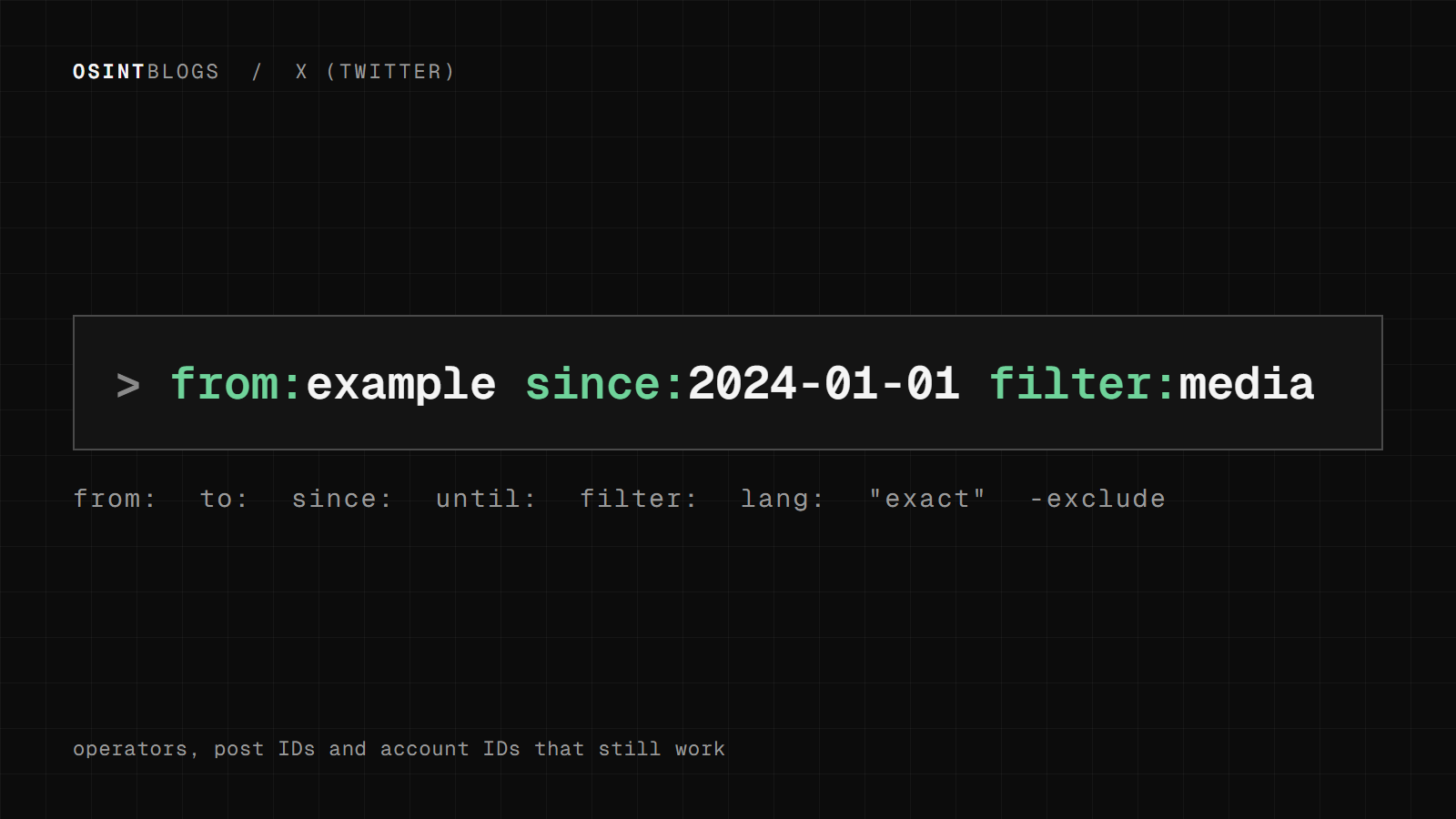
Type these into the search box, then choose the Latest tab so results are in time order. They can be combined.
Operator | Finds |
|---|---|
| Posts containing that phrase |
| Posts by an account |
| Replies to an account |
| Mentions of an account |
| Posts in a date range, by UTC day |
| Posts after a Unix timestamp, for precision to the second |
| Posts with media |
| Posts containing a link |
| Leaves out replies |
| Posts linking to a domain |
| Posts in a language, as classified by X |
| Posts above an engagement level |
| Posts geotagged within a radius |
| Posts from members of a list |
Recipes built from them:
"bridge collapse" filter:videos since:2026-03-01 until:2026-03-02 -filter:replies
from:example until:2019-01-01
to:example "refund" since:2026-01-01
url:example.com -from:example
The first finds original video of an event on the day. The second shows what an account was posting years ago, which often differs sharply from its present subject. The third collects complaints addressed to a company. The fourth shows who else is spreading a website's links.
Cautions: search does not return everything, results vary with your account's settings, and very few posts are geotagged, so an empty geocode: search means little. The operators are not all listed in official help pages and can stop working without notice. If a search matters to your finding, record the exact query and the date you ran it. The general approach carries over from our Google dorks cheat sheet.
Read the account
About this account
Tapping the join date on a profile opens a panel that X introduced in late 2025. It shows where the account is based, when it joined, how many times the username has changed and how the app was installed. For accounts presenting themselves as local voices, a mismatch here is a strong lead.
It is a lead and not proof. The location is derived from signals such as IP address, and VPN use, travel and recent moves all distort it. X flags some accounts where the data may be unreliable.
Check marks
A blue check mark has meant a paid subscription since 2023. It is not confirmation of identity. Gold marks are for subscribing organisations and grey marks for government bodies and officials. Small square badges beside a name show affiliation with a gold-mark organisation.
Behaviour
First posts. Use
from:handle until:with a date shortly after the join date. An account that spent five years posting about cryptocurrency before becoming a regional news source has probably been sold or repurposed.Posting hours. Decode a few hundred post IDs and count posts by hour in UTC. A consistent gap suggests when the operator sleeps. It suggests a time zone range, never a country.
Replies.
to:handleoften surfaces people who know the account holder and address them by name.Source of media. Run profile pictures and banners through reverse image search. See our guide to verifying an image.
For linking a handle to accounts elsewhere, see username OSINT.
Community Notes as a data source
Community Notes are the reader-written context labels shown under some posts. X publishes the full data set for download: every note, including those that were never shown, the ratings, and note status history. For disinformation research this is a rare open record of which claims drew challenge and when. Contributor identities are pseudonymous.
What the API costs you
The official API still exists. The free level is aimed at posting, not reading, and reading at volume is paid. Prices and tiers have changed several times, so check the current developer pages before you plan a project around it. Academic free access ended in 2023. Researchers in the EU can apply for data access under the Digital Services Act.
Unofficial scrapers come and go. They breach the terms of service, break often, and put the account they run under at risk.
Archive early
Posts are deleted, accounts are suspended and handles change. When a post matters:
Save the link in its ID form and note the decoded time.
Take a full screenshot showing the handle, the display name, the text and the counts.
Submit the link to a public archive. The Wayback Machine and archive.today both handle X imperfectly, so try both and check what was captured.
Save the media files separately. Images on X have removed metadata, so the file will not carry camera details.
Hash and log what you saved.
The steps are set out in our guide to preserving web evidence.
A worked example
An account with a city name in its handle posts a video of a protest, and it spreads quickly.
The account ID is long, and decodes to a creation date three weeks ago.
The About this account panel shows two username changes and a base on another continent.
from:handleshows no posts about the city before this week.A search with
"protest" filter:videosand asince:anduntil:range for the day finds the same footage posted forty minutes earlier by a small account with six years of posts from that city.The earlier post's ID confirms the order to the millisecond.
The finding: the video was first posted by the smaller account, and the viral account is a recent, renamed account that reposted it without credit. Whether the footage shows what the caption says is a separate check on the footage itself.
Frequently asked questions
How do I find the exact time a post was made on X?
Take the number at the end of the post link, shift it right by 22 bits and add 1288834974657. The result is the time in milliseconds since 1970, in UTC. The Python snippet above does it.
Can I find deleted posts?
Sometimes. Check the Wayback Machine and archive.today for the post link, look for quote posts and screenshots, and search replies with to:handle around the time. If you have the ID, you at least know when it was posted.
Can I see an account's old usernames?
X shows how many times the name changed, not the names. Old handles often survive in replies from other users, in archived copies of the profile and in search engine results.
Is the location on an X profile reliable?
The location in the bio is free text and can say anything. The location in the About this account panel is X's own estimate, which is better but can be distorted by VPNs and travel.
Does a blue check mark mean an account is verified?
It means the account pays for a subscription and met basic eligibility rules. It does not confirm who runs it.